
Last Updated on 2026-10-16 by Tsubaki
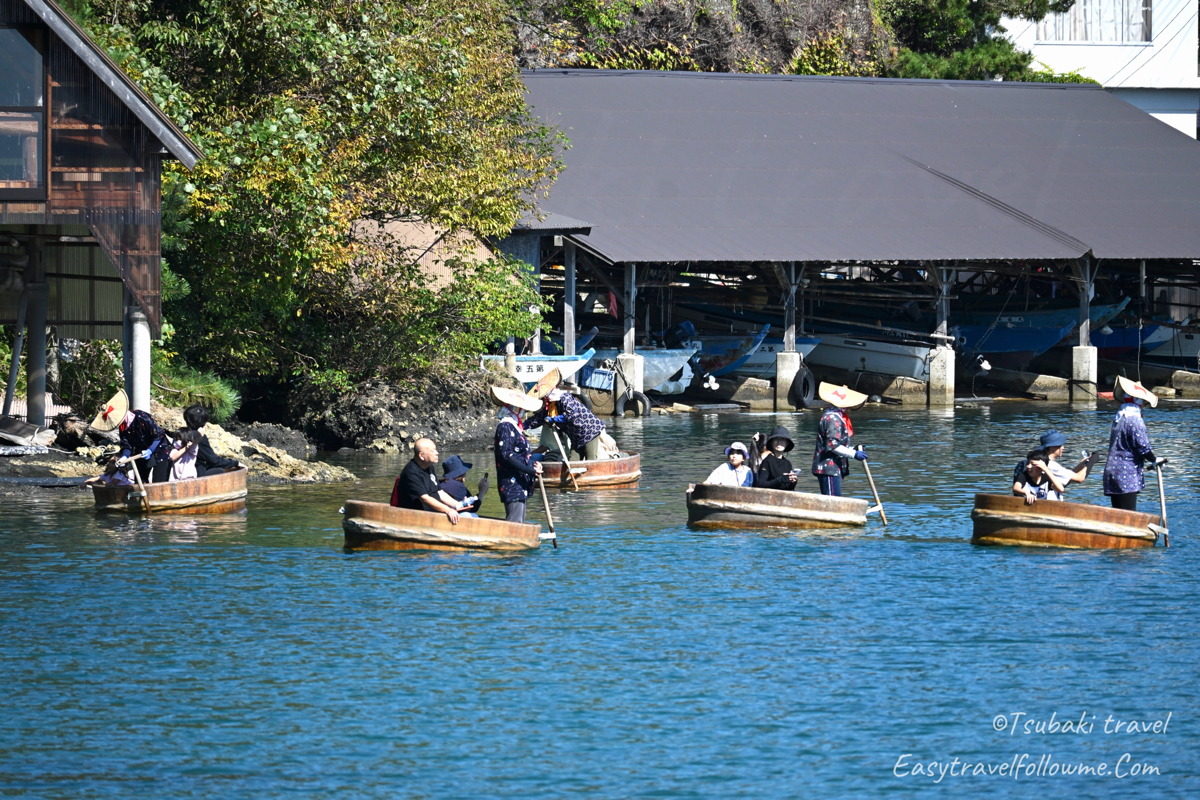
Hi! I’m Tsubaki, a freelance contributing travel journalist who has lived in Japan since 2016! When visiting Sado Island in Niigata Prefecture, there is more to experience than the Sado Island Gold Mines, which became a UNESCO World Heritage Site in 2024. One of the most memorable local traditions in Sado Island is riding a round wooden tub boat called a tarai-bune (たらい舟).
At first glance, it looks like an oversized wooden bathtub. Can people really climb into one and float across the sea? Surprisingly, these unusual boats were originally practical fishing vessels used to gather seaweed, shellfish and other seafood along Sado’s rocky coastline.
There are several places to try a tarai-bune ride. For this visit, I chose Yajima-Kyojima (矢島・経島), where traditional boats glide across remarkably clear water against two green islets and a striking red arched bridge.
One important tip before you go: tickets are sold at the Yajima Experience Exchange Center, not at the waterfront boarding area. We arrived around 9:30 a.m., and by about 10:30 a.m. all tickets for the morning session were already gone! Here is my firsthand guide to prices, getting there, buying tickets, what the ride feels like, photography tips and alternative locations.
Yajima-Kyojima Tarai-bune: Prices, Hours and Access

| Item | Details |
|---|---|
| Experience | Yajima-Kyojima tarai-bune (矢島・経島 たらい舟) |
| Ticket office | Yajima Experience Exchange Center (矢島体験交流館) |
| Address | 365-1 Ogi, Sado, Niigata, Japan (Google Maps) |
| Adult fare | ¥1,000 |
| Child fare | ¥500 |
| Opening hours | Published information varies; phone ahead to confirm |
| Seasonal closure | Generally November through March |
| Reservations | Individuals normally do not need reservations; groups of 10 or more should book ahead |
| Parking | Free, around 20 spaces |
| Telephone | 0259-86-2992 |
These fares are the published 2026 rates. Opening times, ticket quotas and midday breaks may change. Different official pages have listed an 8:00 a.m. or 9:00 a.m. opening and closing times around 4:00–5:00 p.m. I recommend calling 0259-86-2992 before your visit to confirm when tickets go on sale and when afternoon admissions resume.
From our experience, arriving at 9:30 a.m. was already cutting it close: morning tickets had sold out by around 10:30 a.m. If this is a must-do on your Sado itinerary, make it your first stop.
How to get to Yajima-Kyojima
Yajima-Kyojima is in southern Sado Island, close to Ogi Port. It is approximately a five-minute drive from Ogi Port or around 70 minutes from Ryotsu Port. The experience center has a free car park.
By public transportation, take the Ogi Line bus and get off at Yajima Iriguchi (矢島入口); the site is roughly a seven-minute walk away. Check the latest timetable, since buses on Sado are much less frequent than in major Japanese cities.
Personally, I recommend renting a car if you want to see several sights in one day. Yajima-Kyojima, Shukunegi village, Sado Gold Mine and the Kitazawa Flotation Plant are spread across different parts of the island. A rental car also makes it easier to reach Yajima early before tickets sell out.
Renting a car on Sado: Compare pick-up locations, availability, vehicle sizes and rates in advance. The following booking resources and beginner’s driving guide from my site may help.
If you’re unsure how to rent a car in Japan, I recommend TOCOO!, Tabirai, and Klook, all of which offer English website support.
TOCOO! usually provides the lowest rental prices, while Tabirai partners with more rental companies. Klook is convenient for booking. Sometimes, if TOCOO! has no available cars, you may find options on Tabirai or Klook. Comparing different platforms can help you find the best deal!
💡Quick Tip: If you’re not seeing any available cars when searching, it might be because you’re trying to book outside of business hours. Try adjusting your pickup or drop-off time! (Most rental car companies in Japan operate between 8:00 or 9:00 AM and 7:00 or 8:00 PM.)
How to Buy Tickets and Avoid Long Queues

This is the single most important practical detail: go to the Yajima Experience Exchange Center to buy your ticket before heading to the waterfront. The queue near the boats is for boarding, not ticket sales.

Since the boats themselves depart from the shore, visitors sometimes follow the crowd straight to the boarding line. Don’t waste time waiting in the wrong place. First check availability at the ticket office, then take your ticket down to the boat area.
We paid ¥1,000 per adult and joined the boarding queue after purchasing our tickets. In larger groups, you may see some people heading to the line while another person buys tickets.
Morning tickets sold out by 10:30 a.m.

There are limits on how many people can ride during each session because of the number of boats, the experienced rowers and the site’s capacity. We reached the site around 9:30 a.m. and there were already plenty of people waiting. By approximately 10:30 a.m., the morning allocation was sold out and sales stopped.
We were told that afternoon tickets would go on sale after 1:00 p.m. However, official tourism information has also mentioned a break from 11:30 a.m. to 1:30 p.m. Check the on-site notice for the actual resumption time. If morning tickets are gone, you may need to come back later or choose another tarai-bune operator.
Weekends, national holidays and busy travel seasons can be especially competitive. Don’t assume you can turn up in the afternoon and still get a spot.
What Exactly Is a Tarai-bune Tub Boat?

A tarai-bune, also known locally as a hangiri (はんぎり), is a traditional small wooden boat associated with Sado’s Ogi district. Its circular shape evolved for a practical reason: ordinary fishing boats had difficulty navigating the narrow, shallow channels among the area’s many rocks.
Local people developed these flat-bottomed tubs so they could maneuver between reefs while harvesting seaweed, abalone, turban shells and other marine products. A skilled boatperson can steer the round craft using just one paddle.
The craft involved in making Ogi’s traditional tarai-bune has been designated an Important Intangible Folk Cultural Property of Japan. Today, a visitor ride offers a chance to experience a living piece of Sado Island’s maritime heritage.
Why Ride at Yajima-Kyojima? The Red Bridge and Crystal-Clear Bay

If you have seen postcard-like pictures of Sado’s tub boats, they may well have been taken here. Yajima and Kyojima are two little islands surrounded by green trees and clear sea, linked by a vivid red arched taiko bridge.
The crimson bridge, wooded islands and wooden boats floating over turquoise water make an unforgettable scene. The sheltered bay is especially beautiful in sunshine, when you can sometimes see rocks and fish below the surface.
I have tried tarai-bune rides elsewhere on Sado, but Yajima-Kyojima is the place I most recommend for a first visit and for anyone who loves photography. The setting combines cultural heritage with a genuinely lovely natural landscape.
My Firsthand Experience Riding the Yajima Tub Boat
When our turn finally came, I was surprised by how large the wooden boat looked up close. Its round body really does resemble a giant bathtub! I initially wondered whether such a boat would just spin in circles, but the local boatwoman clearly knew exactly what she was doing.
A local boatwoman shares the tradition

Many of the boats here are operated by experienced local women wearing traditional clothing and distinctive Sado-style hats. I affectionately think of them as the ‘tarai-bune grandmas.’ Our guide maneuvered the boat with a single paddle while explaining the boat’s history and how it works.
Her movements looked effortless, but steering something so round must take years of practice. I loved that this was more personal than an ordinary sightseeing cruise: the tradition was being shared directly by someone who knows it firsthand.
Photography note: passengers are required to wear life jackets. They make the ride safer, though the resulting photos may look slightly different from the vintage-looking tub-boat images you have seen online.
The water is clear enough to see fish below
The water was another highlight. I expected only a short ride around the bay, but I could look down and see rocks on the seabed and small fish swimming past. There is even a section in the middle of the tub designed for viewing underwater scenery, and our boatwoman pointed out fish along the way.
When sunlight shines into the bay, the water turns a beautifully transparent blue-green. Rather than just posing for pictures, I found myself slowing down to appreciate Sado’s marine environment.
Want a second ride for photos? You must buy another ticket

I actually hoped to ride twice. The first time, I wanted to share the experience with my boyfriend. For the second ride, my plan was to go alone while he stayed ashore to photograph the boat against the red bridge.
But after asking our boatwoman, we learned that another ride requires another ticket and a new round of queuing. With so many people waiting and the morning quota nearly gone, I gave up on the second trip.
If photos or video are your priority, decide who will shoot from the shore and who will ride before you queue. If you ride together, you can also film each other on board. Whatever you do, stay clear of the boarding area and avoid blocking other visitors.
A little-known detail: the bamboo hoops called taga

Look closely at the outside of a tarai-bune and you’ll notice bamboo bands circling the wooden body. These are called taga (たが). They’re not merely decorative: the hoops hold the wooden staves together and help the tub keep its shape.
Making and maintaining the bamboo bindings requires specialized craft skills, and fewer artisans in Japan still know how to do this work. Some boats reportedly use resin or wax-like protective coatings to slow deterioration, while others use metal hoops.
I was especially fascinated because I had previously visited traditional wooden-barrel makers while reporting on fermentation industries in Aichi Prefecture. Seeing similar craftsmanship on Sado Island felt like an unexpected connection between two journeys.
This simple-looking boat actually brings together woodworking, bamboo weaving and generations of maritime know-how. When you visit, spend a moment studying those hoops, they tell a fascinating story.
Walking Around Yajima-Kyojima: A 10 Minute Island Stroll

Don’t rush away as soon as your boat ride ends. Yajima-Kyojima is also a lovely place for a short walk. The paths offer views of the rocky coastline, leafy trees, quiet bay and red bridge. We walked around Yajima in about ten minutes, although photographers could easily spend longer.
The iconic red arched bridge

The vivid red bridge contrasts beautifully with the surrounding green trees and clear water. Watching a tub boat pass nearby reminded me of a traditional Japanese postcard. Different viewpoints give surprisingly different compositions, so take time to explore the shore after your ride.
Where Else Can You Ride Tarai-bune on Sado Island? Three Locations Compared
If tickets have sold out at Yajima-Kyojima, your day isn’t ruined. There are two other well-known places on Sado Island to try this tradition Tarai-bune, each with a different atmosphere.
1. Rikiya Kanko Kisen — easiest access from Ogi Port

Rikiya Kanko Kisen (力屋観光汽船) is roughly a five-minute walk from Ogi Port. I actually tried its tub-boat experience during my first visit to Sado. Local boatwomen guide the traditional boats, and the operator also offers motorboat sightseeing trips around Ogi’s rocky coastline.
Its convenient port-side location is ideal if you are arriving or departing by ferry. It generally operates year-round, unlike seasonally closed Yajima-Kyojima, but trips may still be suspended during strong winds or rough seas.
Address: 1935 Ogimachi, Sado, Niigata. Official site: Rikiya Kanko Kisen.
2. Shukunegi Hangiri — history and a rocky fishing coast
Shukunegi Hangiri (宿根木はんぎり) offers a different setting, close to the historic fishing village of Shukunegi. The village preserves traditional wooden buildings and is designated an Important Preservation District for Groups of Traditional Buildings.
Instead of Yajima’s iconic red bridge, the draw here is the rocky coastal landscape and connection to historic fishing life. If Shukunegi is already on your itinerary, the boat ride makes a natural addition.
Address: 393 Shukunegi, Sado, Niigata. Access: approximately 15 minutes by car from Ogi Port. Operations are generally seasonal, from spring through autumn; confirm the current year’s dates.
Comparing Sado’s three tarai-bune locations
| Location | Main appeal | Best for |
|---|---|---|
| Yajima-Kyojima | Red arched bridge and exceptionally clear water | First-time visitors and photographers |
| Rikiya Kanko Kisen | Near Ogi Port; other sightseeing boats available | Visitors with limited time or a ferry connection |
| Shukunegi Hangiri | Historic fishing village and rocky shore | Travelers interested in local history and nature |
My first choice is still Yajima-Kyojima for the classic scenery. However, the other options are worth considering if tickets are sold out or if your route takes you closer to Ogi Port or Shukunegi.
Final Thoughts
Before this trip, I thought a tub-boat ride would simply be a quirky photo opportunity. Actually getting into one changed my perspective. The gentle paddling, clear water and local boatwoman’s skill made me appreciate how closely Sado’s everyday life has long been connected to the sea.
The red bridge and green islands really are as photogenic as they look. Although I never got that second solo photo shoot, riding together with my boyfriend was a special memory in its own right.
If you’re planning a Sado Island itinerary, I wholeheartedly recommend a stop at Yajima-Kyojima. Just remember the two essentials: buy your ticket at the Experience Exchange Center first, and arrive early.
Tarai-bune on Sado Island FAQ
Where can you ride a tarai-bune on Sado Island?
Three popular locations are Yajima-Kyojima, Rikiya Kanko Kisen near Ogi Port, and Shukunegi Hangiri. Yajima-Kyojima is especially famous for its red arched bridge and crystal-clear bay.
How much is the Yajima-Kyojima tub boat ride?
From April 2026, published fares are ¥1,000 for adults and ¥500 for children. Tickets must be purchased at the Yajima Experience Exchange Center.
Do I need to book in advance?
Individual visitors normally do not need advance reservations, but availability is limited and tickets can sell out. Groups of ten or more should make reservations in advance.
When do afternoon tickets go on sale?
Staff told us that afternoon tickets would resume after 1:00 p.m., while other official information has listed an admission break from 11:30 a.m. to 1:30 p.m. Confirm the actual schedule on the day.
How long should I allow for Yajima-Kyojima?
Walking around Yajima alone takes about ten minutes. For the tub-boat experience, ticket purchase and queuing, allow at least an hour — and more during busy periods.
**********************
Traveler’s Note:
The insights shared above are based on my personal experiences and subjective perspectives. When planning your trip, please consider current weather conditions and your own travel preferences.
Please note that all English articles on this site are AI-assisted translations of the original Traditional Chinese content. While every effort is made to ensure accuracy and natural flow, occasional nuances or expressions may differ. Thank you for your understanding.
In an era dominated by viral trends and “clickbait” locations, my true passion lies in exploring hidden corners and regions where information is scarce. I know firsthand how precious detailed, reliable information is when planning a journey. That is why I dedicate countless hours to research and field exploration, to curate these hard-earned insights for fellow travelers like you.
Every article and image on this site represents a significant investment of time and heart. If this content has helped you, the best way to support me is by sharing or reposting this link. I kindly ask that you respect original creators; unauthorized copying or re-uploading is strictly prohibited (all content is protected under DMCA).
Catch my latest travel moments on Instagram: @287.travel
Fuel my next journey: If my guide made your trip smoother, feel free to [Buy Me a Coffee]. Your support keeps this project moving forward!
Thank you for being a part of this community.

**********************
Klook.com