
Last Updated on 2026-03-01 by Tsubaki
Sometimes the world works in a strangely fascinating way. It’s as if there’s an invisible thread quietly pulling you toward a certain place.
My boyfriend and I finished watching the Japanese drama The Days, and the shock stayed with us for a long time. It’s a dramatized, record-based portrayal of the 2011 Fukushima Daiichi nuclear power plant accident. And while that disaster has faded in the public’s memory, mentioned less and less as the years pass. But for us, the question “ What Happened to Fukushima After the Nuclear Disaster ?” remained like an unanswered riddle.
Inspired by the series, we seriously considered joining one of the special tours that lets you enter the areas surrounding the nuclear plant, so we could see with our own eyes those places that still exist on the map, yet can’t truly be stepped into, to trace what history left behind, to see what those traces look like now, and to understand what changes this man-made disaster forced upon the land. But we never expected these tours to be so popular. We couldn’t get a spot at all.
Along National Route 6: Looking Straight at Reality

So my boyfriend and I chose another way to get closer.
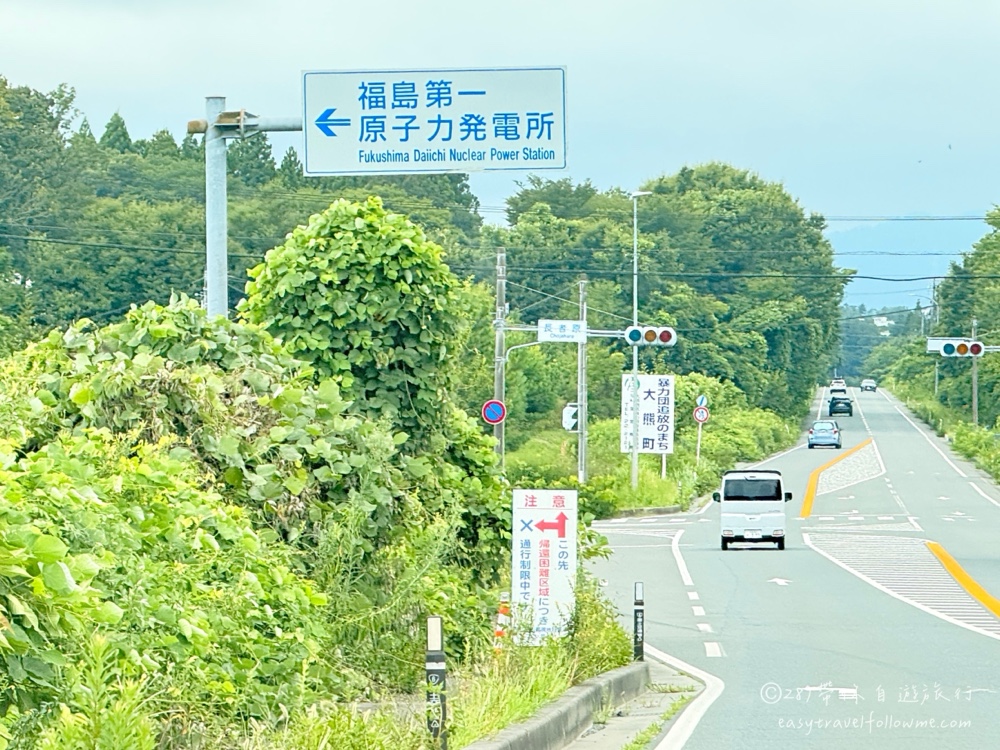
During the Obon holiday, we drove up to Tohoku for a road trip, and we deliberately picked National Route 6, the road that runs along the Fukushima coast.

Outside the car window, you could still see patches of land sealed off and overgrown with wild grass. Yet the radiation readings on the dashboard weren’t as frightening as I had imagined. They were already within a range that felt acceptable.

The fences and warning signs along the roadside quietly reminded us that this was still a place you can’t simply walk into. As we drove through, I couldn’t quite call what I felt “sadness.” It was more like awe, mixed with something complicated.
The land is still there. The houses are still there. But the people are not.
A Fukushima Company Visit: Even “By Chance” Can Be a Kind of Fate
Maybe it really was one of those unseen arrangements. Not long after that drive, I unexpectedly received an invitation to join a field visit to local companies in Fukushima.
That visit gave me a chance to speak directly with businesses that are still working on the ground, to hear how they look for a way forward in the middle of adversity. What I saw wasn’t a group of disaster victims with their heads down.
I saw people with bright eyes.
Each of them was holding on to their hometown with an almost stubborn kind of passion. Some were growing sweeter fruit. Some were using modern thinking to turn old industries around. That determination, that feeling of “I’m going to make Fukushima shine again,” was unmistakable.
And that kind of life force, truly, is contagious.
The Strength and Hope of Fukushima’s Companies
Public Interest Incorporated Foundation Fukushima Innovation Coast Framework Promotion Organization

A grand dream to rebuild the industries that were lost back then, brick by brick, tile by tile. And in truth, this entire framework was born precisely because of the nuclear disaster.
The Public Interest Incorporated Foundation Fukushima Innovation Coast Framework Promotion Organization (福島イノベーション・コースト構想推進機構) is a national-level initiative established by the Japanese government after the disaster to revitalize Fukushima’s Hamadori region. Behind its creation is a deep sense of reflection and resolve: if another disaster ever strikes, can we use technology to protect people? That’s why they place particular emphasis on developing robotics, technology designed to step in and make a difference when disasters happen.

Their focus spans decommissioning, robotics, agriculture, forestry and fisheries, energy, and environmental regeneration. But what they do goes far beyond constructing facilities. They are also working on the bigger picture: building industry clusters, nurturing talent, and creating real population flow, the kind that makes a region truly live again.

What impressed me most was the Fukushima Robot Test Field (RTF, 福島ロボットテストフィールド) they helped create. The site is said to be on the same scale as Disneyland, and it is the largest robot testing ground in Japan. Robots that climb through rubble, robots that move through water, and robots that fly in the sky all train here again and again, practicing how to protect humans.
Official website: https://rtf.f-rei.go.jp
Zip Infrastructure Co., Ltd.

This company is one of the businesses that actively conduct testing at the Fukushima Robot Test Field (RTF). They chose Fukushima because it can offer the kind of ample testing space they need, especially for large-scale systems like theirs, which require wide-open areas for long-distance operation and repeated trials.
Zip Infrastructure has developed a transportation system called “Zippar.” Simply put, it combines the concept of ropeways and monorail technology. Unlike traditional ropeways or monorails that require heavy, reinforced concrete structures, Zippar can operate with just a few lightweight cables. It moves lightly above the city, turning and weaving through the air.
Technically, it’s closer to a monorail, but because it uses cables as its “track,” construction costs can be lower and installation can be far simpler.
What’s more, the design is flexible. It breaks through the limitation of traditional ropeways that can only run in a straight line, allowing routes to be planned according to terrain and real urban needs. This kind of next generation transit system has real potential for dense city spaces, high foot traffic districts, or areas with complex geography. It feels full of possibility, and it also shows Fukushima’s unique position as a place where advanced technology can be tested and proven.
Watching that futuristic cabin glide through the air honestly felt like stepping into a sci-fi film. Standing there in person, I could see it in the eyes of COO Mario Ian Carlos Ferido Rebonquin. They were shining with passion and belief. And through that gaze, I could feel how strongly he was looking toward the future. It gave me an extra layer of hope that this technology might truly become reality.
Official website: https://zip-infra.co.jp/index.html
Fukushima Hydrogen Energy Research Field

These past few years, everyone has been talking about green hydrogen, but in Fukushima, it has already been quietly put into practice.
The Fukushima Hydrogen Energy Research Field (福島水素エネルギー研究フィールド) is located in Namie Town, Futaba District, Fukushima Prefecture. It is considered one of the world’s largest hydrogen production facilities based on renewable energy. When you step inside, what you see first is an endless stretch of solar panels. The land feels wide open, and somehow it gives you both an overwhelming sense of the future and a surprising sense of grounded certainty.
This facility combines solar power generation with the local power grid. Using high output water electrolysis equipment, it splits water to produce hydrogen, while also conducting demonstration experiments for storage, supply, and flexible output. In simple terms, it turns sunlight into electricity, and then turns that electricity into hydrogen.
What moved me most was this: a place that once carried the weight of disaster is now being seen by the world again in the cleanest possible way. This is not only a research site. It feels more like a statement, telling the world clearly that Fukushima is stepping into the future through innovation and clean energy.
Rice Resin

In Namie Town, I came across another way of thinking about “rebirth” a story that belongs to rice, and to the land itself.
The company is called Rice Resin. They take rice that can no longer be eaten, including government stockpiled rice that has reached the end of its storage period and would otherwise be discarded, and transform it into an eco-friendly resin that helps reduce carbon emissions. It doesn’t just cut waste. It also creates new value for local agriculture.
One of the speakers was a member of the team who is originally from Fukushima. In a calm voice, he mentioned how the great earthquake and tsunami back then took several of his close friends. He also spoke about why he wanted to develop this technology in the first place: because he didn’t want Fukushima to be labeled as “bad for the environment” forever. He wanted Fukushima to show the world a completely new face.

What makes Rice Resin especially unique is that it uses domestic Japanese resources, rather than relying on imported materials like corn or sugarcane. The process is simple, the cost is low, and it has even attracted international attention. Even better, they work with local farmers to promote what they call “resource rice,” allowing farmers to flexibly switch what they grow while also revitalizing farmland that had been left unused.

Rice that was once destined for the trash has now become a material that could benefit the world.
This is what real revitalization looks like: turning regret into hope.
HANERU Katsurao Co., Ltd.

If the robots and hydrogen energy projects felt like big technological dreams, then arriving at HANERU Katsurao gave me a different kind of feeling: a grounded, everyday passion for life.
Because who would have imagined this? In the mountains of Fukushima, people are farming shrimp.

This is a lively local company that built a circular, recirculating tank system in Katsurao Village, developing a land-based aquaculture model that doesn’t pollute the environment and still enables stable production. This type of freshwater shrimp was once difficult to supply consistently, but they managed to raise it indoors, successfully, and even turned the facility into a place where families can come and enjoy a hands-on “shrimp fishing” experience.
There, we met an incredibly lovable team,
and one member had even come all the way from Colombia. Behind that was a surprisingly beautiful twist of fate.
The story is genuinely fascinating. He had been working in shrimp aquaculture back in Colombia, and when he came to Japan to explore opportunities, he visited many places but couldn’t find a site that felt right. Later, his son, who was studying at Fukushima University, told him he’d heard that someone in the mountains of Fukushima was actually farming shrimp. At first, he didn’t believe it was possible to raise shrimp in a mountainous area like this. But after reaching out to the owner and visiting in person, he discovered that their recirculating warm-water aquaculture system was remarkably solid and well-built.
His decision to join as an international professional has become one of the company’s defining strengths. Watching him continue to deepen the technology here in Fukushima’s mountains, I realized something: the energy of Fukushima’s revitalization is drawing in talent from around the world, not through hype, but through a kind of openness and professionalism that feels quietly powerful.
Official website: https://haneru-katsurao.com
Final Thoughts

This journey began with The Days on a screen. It carried me down National Route 6, past those silent stretches of sealed-off land and overgrown fields. But in the end, what stayed with me most were the people, the ones who were quietly shining.
I realized that real revitalization isn’t about erasing the scars of the past. It’s about doing what these companies are doing: carrying those scars, and still cultivating new possibilities on the same land with wisdom and courage.
Everyone I met helped me see Fukushima again, with fresh eyes. Their persistence isn’t meant to prove anything to anyone. It comes from a simple belief:
“This place is worth staying for. Worth living in. Worth creating for.”
And as someone who was only passing through, I feel genuinely grateful that I got to witness that kind of strength in person.
I also hope that through this article, more people will understand that Fukushima’s story is still unfolding. It’s not only about reconstruction. It’s about continuously creating new value and new hope.
**********************************
Traveler’s Note:
The insights shared above are based on my personal experiences and subjective perspectives. When planning your trip, please consider current weather conditions and your own travel preferences.
Please note that all English articles on this site are AI-assisted translations of the original Traditional Chinese content. While every effort is made to ensure accuracy and natural flow, occasional nuances or expressions may differ. Thank you for your understanding.
In an era dominated by viral trends and “clickbait” locations, my true passion lies in exploring hidden corners and regions where information is scarce. I know firsthand how precious detailed, reliable information is when planning a journey. That is why I dedicate countless hours to research and field exploration, to curate these hard-earned insights for fellow travelers like you.
Every article and image on this site represents a significant investment of time and heart. If this content has helped you, the best way to support me is by sharing or reposting this link. I kindly ask that you respect original creators; unauthorized copying or re-uploading is strictly prohibited (all content is protected under DMCA).
Catch my latest travel moments on Instagram: @287.travel
Fuel my next journey: If my guide made your trip smoother, feel free to [Buy Me a Coffee]. Your support keeps this project moving forward!
Thank you for being a part of this community.

**********************************
