Last Updated on 2026-03-01 by Tsubaki
When people think of Ueno, the first things that often come to mind are the Ueno Zoo, Ameyoko shopping street, or cherry blossom viewing in Ueno Park. But what many may not realize is that right inside Ueno Park stands a UNESCO World Cultural Heritage Site: The National Museum of Western Art.
This isn’t just a museum housing masterpieces of Western art; the building itself is a world-class cultural treasure, rich in both historical and architectural significance. That’s why many international visitors make it a point to stop by when exploring Tokyo.
Taking advantage of a rainy day, I decided to spend some quiet time discovering this UNESCO site. The rain kept the crowds away, making it the perfect chance to slowly appreciate the museum’s architectural details and the tranquil atmosphere inside the galleries.
In this article, I’d love to share with you the story behind The National Museum of Western Art. Its unique architectural features, and my personal impressions and little discoveries from the visit. Hopefully, it will help you see the hidden beauty of this World Heritage Site too.
Switch language:繁體中文
The National Museum of Western Art in Ueno, Tokyo

The National Museum of Western Art is located right inside Ueno Park in Tokyo. From the Park Exit of JR Ueno Station, it takes less than a minute on foot, just look to your right and you’ll spot a sleek, modern-looking building.

You don’t need a ticket to admire the museum’s architecture or the outdoor sculptures, but if you’d like to explore the permanent collection of Western art inside, an admission ticket is required.

The general admission fee is ¥500 (approximately $3.35 USD). For that price, you not only get to enter a UNESCO World Cultural Heritage Site, but also view original works by masters like Monet and Van Gogh. Compared to many private museums in Japan that charge over ¥1,000, this is an incredible deal for such high cultural value. (Electronic payments are accepted!)

Photography is generally allowed inside the museum, with the exception of a few specific works. As long as the photos are for personal use and you avoid flash or tripods, you’re free to take pictures as keepsakes.
✔️The National Museum of Western Art – Visitor Info
Address: 7-7 Uenokoen, Taito City, Tokyo 110-0007 (Google Maps)
Access:
・1 min walk from JR Ueno Station “Park Exit”
・5 min walk from Tokyo Metro Ginza Line / Hibiya Line “Ueno Station”
・7 min walk from Keisei Electric Railway “Keisei Ueno Station”
Opening Hours:
・Tuesday to Thursday: 9:30 AM – 5:30 PM
・Friday to Saturday: 9:30 AM – 8:00 PM
・Closed on Mondays
Admission (Permanent Collection):
・Adults: ¥500 (~$3.35 USD)
・University students: ¥250 (~$1.70 USD)
・Free for high school students and under, and seniors aged 65+
Free Admission Days:
・2nd & 4th Saturday of each month
・International Museum Day (May 18)
・Culture Day (November 3), and other select days
Additional Info: Tickets can be purchased in advance via the official website. Simply scan your QR code to enter.
Origins of the Museum

After World War II, the French government decided to return the Matsukata Collection*. Which had been seized during the war, back to Japan. In order to house and exhibit this valuable collection of Western art, Japan began construction of a dedicated museum.

One of the conditions for the return of the collection was that a new museum would be built to house it. In 1955, the Japanese government invited the world-renowned modernist architect Le Corbusier to design the building. This resulted in the only Le Corbusier-designed structure in East Asia.
*The Matsukata Collection: A carefully curated selection of Western art assembled in France by Kojiro Matsukata, then-president of Kawasaki Shipbuilding Company.
A UNESCO World Cultural Heritage Site

In 2016, The National Museum of Western Art was officially designated as a UNESCO World Cultural Heritage Site. Interestingly, it was not the museum’s collection that earned it this title, but rather its architectural significance as a creation of Le Corbusier, one of the founding fathers of modern architecture.
The museum is part of the inscription titled “The Architectural Work of Le Corbusier, an Outstanding Contribution to the Modern Movement.” This listing includes 17 sites across seven countries, with Japan’s National Museum of Western Art being one of them.
This designation is not only a Serial Nomination Site (a World Heritage property made up of multiple locations), but also Japan’s first transboundary World Heritage Site, shared with other nations in recognition of Le Corbusier’s global influence.
Le Corbusier: One of the Most Influential Architects of the 20th Century
Le Corbusier is hailed as one of the most important and influential architects of the 20th century. He revolutionized European architecture by breaking away from the traditional load-bearing wall structure and introducing the innovative concept of pilotis, or structural columns that lift a building off the ground. While this is now a common principle in modern architecture, at the time it was a groundbreaking departure from convention. His ideas redefined architectural language and had a profound global impact, which remains part of his enduring legacy.
The National Museum of Western Art is the only building designed by Le Corbusier in East Asia, and it was completed under the supervision of his Japanese disciples Kunio Maekawa and Junzo Sakakura. The museum reflects Le Corbusier’s concept of a “Museum of Unlimited Growth,” merging functionalism with geometric aesthetics, and is considered a modernist masterpiece.
The 17 Architectural Works Listed as World Heritage Sites

The museum is part of the UNESCO inscription titled “The Architectural Work of Le Corbusier. An Outstanding Contribution to the Modern Movement.” This listing includes 17 architectural sites across seven countries, recognizing Le Corbusier’s global contribution to the development of modern architecture.
Here is the complete list of the 17 sites:
1. Argentina|Maison du docteur Curutchet
2. Belgium|Maison Guiette
3. Germany|Maisons de la Weissenhof-Siedlung
4. India|Complex of the Capital, Chandigarh
5. Japan|The National Museum of Western Art
6. Switzerland|
・Petite villa au bord du lac Léman
・Immeuble Clarté
7. France|
・Maisons La Roche and Jeanneret
・Cité Frugès
・Unité d’habitation in Marseille
・Manufacture à Saint-Dié
・Chapelle Notre-Dame-du-Haut
・Convent at Saint-Marie-de-la-Tourette
・Centre de recréation du corps et de l’esprit at Firminy-Vert
・Immeuble locatif à la Porte Molitor
・Villa Savoye, together with its gardener’s house
・The Cabanon of Le Corbusier
Together, these buildings showcase Le Corbusier’s visionary role in shaping 20th-century modern architecture.
Notable Design Features of the Museum
Exterior Walls Adorned with Green Pebbles

As you enter the museum, one of the first things you’ll notice is the rough-textured walls covered with greenish pebbles, seen both on the exterior and certain interior sections.

This design not only adds visual depth and texture to the surface, but also reflects Le Corbusier’s philosophy of material authenticity. In an era when modern architecture was dominated by concrete and steel, the use of pebbled surfaces adds a sense of warmth and natural tactility, striking a balance between rational structure and emotional resonance.
The 19th-Century Gallery Hall

At the heart of the museum is a spacious double-height central hall, designed as a circulatory hub connecting the second floor and mezzanine with open, layered spaces. It’s not only a core element of the building’s layout but also a direct expression of its architectural philosophy.

The ceiling features triangular skylights that let in natural light, while load-bearing columns and exposed concrete flooring create a bold, minimalist aesthetic in true modernist style.

A gentle ramp winds through the space, allowing visitors to move freely between levels without using stairs. This design makes the museum visit more than just a visual experience, it becomes an immersive architectural journey, where visitors feel like they are walking into the structure itself.
The “Museum of Unlimited Growth”
The concept of a “Museum of Unlimited Growth” was introduced by Le Corbusier to address the evolving nature of museums. According to this idea, a museum’s architecture should be flexible and expandable, allowing the structure to grow organically as collections increase or exhibition needs change, without disrupting the original architectural logic. The National Museum of Western Art stands as a prime example of this visionary concept.
Le Corbusier designed the museum’s circulation in a spiral-like flow, leading visitors chronologically from 19th-century Western art into the early 20th century. It feels almost like walking through a labyrinth where architecture and art history intertwine, guiding you step by step along a temporal journey.
The Pilotis: Elevated Columns That Open Up Space

One of Le Corbusier’s Five Points of Architecture was the pilotis, structural columns that lift the building above ground. This “elevated colonnade” design frees the ground level from traditional load-bearing walls, allowing open circulation and multi-functional use of the first floor.

This approach enhances natural ventilation and lighting, while also offering a more fluid pedestrian experience and broader visual perspective. It embodies the spirit of openness and flexibility central to modern architecture. At the National Museum of Western Art, the entrance is defined by this pilotis design, paired with abundant natural light and minimalist lines.
Natural Light Gallery: Lighting That Honors the Art
Le Corbusier placed great emphasis on the use of natural light, and this is reflected in the museum’s “natural light gallery”. By incorporating skylights and narrow clerestory windows near the tops of the walls, he introduced gentle daylight into the exhibition spaces.

This design allows artworks to be softly illuminated without relying heavily on artificial lighting, reducing glare and maintaining the original vibrancy and texture of each piece. Although some windows have been adapted to accommodate preservation needs and now use artificial lighting system. The overall layout still preserves Le Corbusier’s vision of a light-filled space.
Exhibition Highlights at the National Museum of Western Art
The Matsukata Collection


At the heart of the museum’s permanent collection is the Matsukata Collection, assembled by Kojiro Matsukata. It spans European art from the 14th to early 20th centuries, featuring original works by legendary artists such as Monet, Renoir, Rodin, Van Gogh, and Picasso.
Some of the most well-known pieces include Monet’s Water Lilies, Van Gogh’s Roses, and Picasso’s Man and Woman.
You can browse current exhibitions on the official website.
Sculpture Garden: Free to the Public


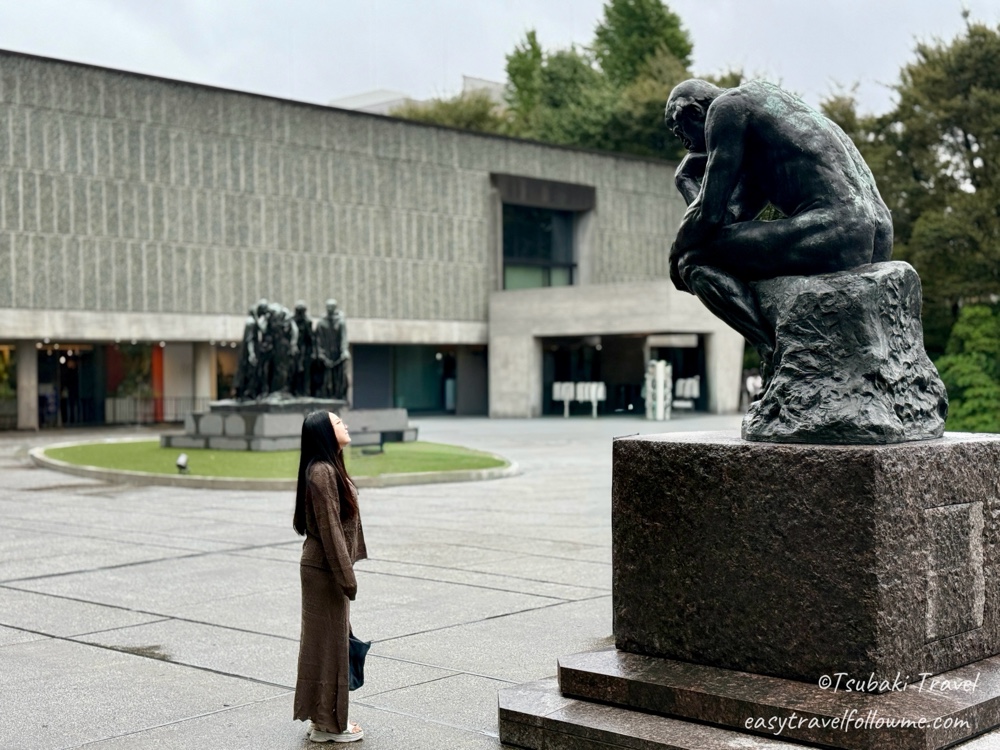
Even if you don’t enter the museum, you can still enjoy the outdoor sculpture garden, which is open to the public free of charge. Here, you’ll find Rodin’s masterpieces, including The Gates of Hell and The Thinker.
The Thinker displayed here is a larger-scale version, but it was personally carved by Rodin himself, retaining its full artistic impact and emotional power.
In Conclusion
The National Museum of Western Art is far more than a space for viewing European paintings, it’s a cultural landmark that bears witness to the evolution of modern architecture. Whether you’re an art lover, a design enthusiast, or simply looking for a quiet place to reflect, this UNESCO World Heritage Site in Ueno deserves a spot on your Tokyo itinerary.
Although I’m not an architecture or design professional, this article is the result of extensive research, personal observation, and my first-hand experience visiting the museum. I’ve done my best to present the beauty and depth of this site in an accessible way, and I hope it inspires you to discover the charm of this architectural treasure for yourself.
Selected References:
・The architectural work of Le Corbusier an outstanding contribution to the modern movement inscribed on the unesco world heritage list
・国立西洋美術館公式サイト
**********************************
Traveler’s Note:
The insights shared above are based on my personal experiences and subjective perspectives. When planning your trip, please consider current weather conditions and your own travel preferences.
Please note that all English articles on this site are AI-assisted translations of the original Traditional Chinese content. While every effort is made to ensure accuracy and natural flow, occasional nuances or expressions may differ. Thank you for your understanding.
In an era dominated by viral trends and “clickbait” locations, my true passion lies in exploring hidden corners and regions where information is scarce. I know firsthand how precious detailed, reliable information is when planning a journey. That is why I dedicate countless hours to research and field exploration, to curate these hard-earned insights for fellow travelers like you.
Every article and image on this site represents a significant investment of time and heart. If this content has helped you, the best way to support me is by sharing or reposting this link. I kindly ask that you respect original creators; unauthorized copying or re-uploading is strictly prohibited (all content is protected under DMCA).
Catch my latest travel moments on Instagram: @287.travel
Fuel my next journey: If my guide made your trip smoother, feel free to [Buy Me a Coffee]. Your support keeps this project moving forward!
Thank you for being a part of this community.

**********************************