
Last Updated on 2026-03-01 by Tsubaki
When people think of Sendai, what often comes to mind is gyutan (beef tongue), the Sendai Morning Market, Sendai Castle, or maybe just a convenient stopover when heading to other parts of the Tohoku region. But Sendai itself holds plenty of surprises. One place that really stood out to me was the Sendai Tomizawa Site Museum (地底の森ミュージアム), located not far from Sendai Station.
This isn’t your typical museum. It’s a site where you can literally walk into the remains of a forest from the Ice Age, dating back 20,000 years. It feels like stepping through a time portal, seeing firsthand how people lived back then and what the natural environment looked like. In this article, I’ll share my experience exploring this ancient underground forest.
What Makes the Sendai Tomizawa Site Museum Special?

Located in Sendai’s Taihaku Ward, the museum’s full name is the Sendai City Tomizawa Site Preservation Museum. Its main highlight is a perfectly preserved section of an Ice Age forest.
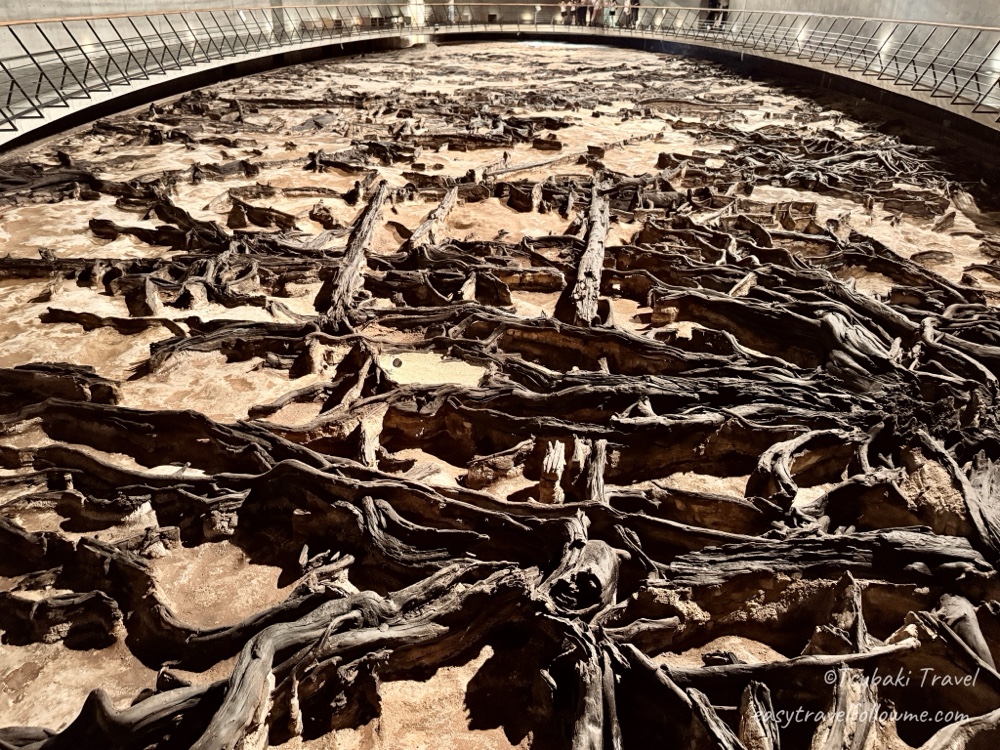
The site was discovered in 1988 during construction work for a planned elementary school. While clearing the land, workers noticed unusual soil layers. Archaeological investigations followed, and an entire ancient site was uncovered and preserved. What was found included the original trunks and roots of coniferous trees such as fir and hemlock, buried underground by volcanic activity, as well as traces of prehistoric human life. This is one of the rare few sites in the world where such remains are preserved and displayed in situ, meaning in their original location.
Why Is It So Unique?
A Globally Rare In-Situ Preservation Site

The Tomizawa Site is remarkable not only because Ice Age forest remains were discovered, but also because they were preserved right where they were found. Visitors don’t just see replicas or relocated exhibits, they’re looking at the actual earth layers from 20,000 years ago, carefully excavated and maintained in place. This kind of preservation is exceptionally rare worldwide, allowing us to directly witness both ancient nature and human activity.
When Volcanoes and Forests Coexisted

The unique preservation here is thanks to a volcanic eruption more than 20,000 years ago. Ash and mudflows from the eruption completely covered the forest, sealing trees, plants, and even traces of human life in a natural time capsule.

What’s astonishing is that most of the preserved forest consists of now-extinct conifers, along with some broadleaf species. The preservation is so detailed that even tiny things like deer droppings and insect wings have been found. Carefully excavated and conserved, these remains give us an incredibly vivid glimpse into what the Ice Age ecosystem really looked like.
Traces of Human Life

Beyond the forest itself, archaeologists uncovered several fire pit remains and more than 100 stone tools, believed to have been left behind by Paleolithic humans for warmth and cooking.
The most extraordinary part is that here, in one single location, you can see both Ice Age forest remains and evidence of Paleolithic human activity. According to the museum, this combination is found nowhere else in the world, making it truly invaluable. These interwoven natural and cultural traces don’t just serve academic research; they also allow us to vividly imagine how people once lived in this ancient environment.
Information sources: Conversations with volunteer guides, museum brochures, on-site exhibits, and the official website.
Highlights and Facilities Inside the Museum

The entire design of the museum is incredibly thoughtful. The entrance isn’t at ground level, it’s hidden underground! So you actually start by walking down a staircase to officially enter the exhibition space.
The building itself is structured with a spiral layout. At the very bottom is the main attraction: the underground forest ruins. As you gradually move upward, you’ll encounter supplementary exhibits and archaeological displays. This “from ancient to modern” progression is a creative and meaningful touch, almost like walking through history layer by layer back into the present.
Underground Excavation Zone
The main underground exhibit is a large-scale excavation site. The space is temperature- and humidity-controlled to replicate conditions from 20,000 years ago. You’ll be able to clearly see preserved fir tree roots, volcanic ash layers, stone tools, and cross-sections of ancient soil, all incredibly powerful to witness up close.

Inside the excavation zone, a short 10-minute reconstruction video plays at 10, 30, and 50 minutes past the hour. Based on archaeological findings, the video reenacts what life might have been like during the Paleolithic era.

The scenes depict Ice Age humans making fire, repairing broken hunting tools, and cooking food over open flames. Although it’s a simple presentation, the combination of the real ruins under your feet and the visual story playing before your eyes makes it easy to imagine, real people lived right here 20,000 years ago.
Educational & Permanent Exhibits

The permanent exhibition explains the discovery of the Tomizawa site, preservation techniques, and Ice Age climate changes. Through models, specimens, and videos, you can dive deeper into the archaeological background of this underground forest.
Accessibility

The museum features a long, sloped entrance specially designed for wheelchair users or anyone with mobility issues, making it easy for everyone to enjoy the exhibits.
Coin Lockers

Coin-operated lockers are available for visitors. Each locker costs ¥100 (about $0.64 USD) to use. It’s a convenient option if you’d rather explore without carrying bags around. Just note that the lockers are quite small and may not fit large suitcases, best to use them when traveling light.
Access & Visitor Info

The Sendai Tomizawa Site Museum is very easy to reach. From Sendai Station, just hop on the Subway Namboku Line, and it’s about a 5-minute walk from Nagamachi-Minami Station. If you’re driving, there’s a free parking lot outside that can accommodate around 20 cars.
✔️ Sendai Tomizawa Site Museum(地底の森ミュージアム)
Address: 4 Chome-3-1 Nagamachiminami, Taihaku Ward, Sendai, Miyagi 982-0012 (Google Maps)
Access: Take the Subway Namboku Line from Sendai Station to Nagamachi-Minami Station, then walk about 5 minutes.
Hours: 9:00 AM – 4:45 PM (Closed on Mondays)
Admission:
・Adults: ¥460 (approx. $3.00 USD)
・High school students: ¥230 (approx. $1.50 USD)
・Junior high school students and younger: Free
Note: Cash only
Official website
Personal Visit & Impressions
Entering the Museum & Getting Tickets

When we first arrived at the museum entrance, the area felt so quiet and empty that I couldn’t help but feel a little uneasy. I even wondered, “Is this place going to be kind of boring?” From the outside, it looked extremely modest. But then again, it is called the “Underground Forest” in Japanese, so having the building buried below ground kind of makes sense. Maybe the understated entrance was designed that way to help preserve the ruins inside.
First Glimpse of the Exhibit

As soon as we stepped into the underground exhibition room, a reconstruction video of the Stone Age happened to be playing. The whole room was pitch dark, and for a moment I thought, “How are we even supposed to see anything in here?” Turns out, the lights are turned off intentionally to create an immersive atmosphere during the video.
Once the video ended and the lights slowly came back on, it all started to make sense, and wow, what a reveal!
Traces of Fire & Mysterious Little Pits


Inside the exhibit, you can clearly see blackened ash layers from ancient fires, along with several small pits thought to have been used to hold stone tools. These are all signs of Paleolithic human activity.
But here’s the fun part, nobody really knows exactly what those little holes were for. While the current theory is that they were used for storing tools, the real purpose remains a mystery. When one of the museum staff explained it to us, even they had a puzzled smile, saying something like, “Honestly, we’re still not sure.” It really made me feel like even if I traveled back in time, I might still not fully understand how ancient people thought.
Friendly and Passionate Volunteer Guides

The guides here are all volunteers, and they’re incredibly warm and welcoming. If they see you looking a bit lost or confused, they’ll come over right away and offer to explain things.
That day, one of the volunteer guides brought us over to a wall display showing different soil layers from various time periods. She pointed out which layers represented which era, helping us truly visualize just how deeply the “underground forest” was buried. It gave us a real sense of the scale and depth of the ruins!
Hands-On Comparison of Preserved vs. Unpreserved Wood

There was one little corner I found super interesting: a hands-on station where you could actually touch a piece of preserved wood, alongside a completely untreated piece for comparison. They even provided hand sanitizer so you could clean your hands before touching. Getting that close to something from the Ice Age was such a fresh and exciting experience!

The preserved wood felt noticeably damp and had a really unique texture, neither like a living tree nor like dried wood. That moist, slightly spongy feeling is hard to describe, but unforgettable.
Seeing the Forest from a New Angle


Just when you think the visit’s over, it’s not! Follow the stairs upward and you’ll reach a high platform that lets you look down over the entire excavation site. From this angle, you can really take in the full scale of the earth layers and ruins, it adds another level of visual impact.

There’s also a 3D viewer set up along the platform railing. If you look inside, you’ll see what the site looked like when the ruins were first discovered. It’s like getting a front-row seat to an archaeological dig. The sense of immersion is so strong, I found myself staring into it for ages, completely drawn in.
First Floor Permanent Exhibition

After leaving the underground exhibition area, the first floor features a permanent exhibit filled with supplementary information about the underground forest, such as giant preserved tree specimens, Ice Age flora and fauna, and more.


There’s also a display of human skull models, allowing you to compare the cranial structure of humans from 20,000 years ago with that of modern humans. Although these skulls weren’t excavated from this site (they’re from other locations), they still help give a clearer picture of what ancient humans may have looked like.


But to be honest, the part that left the deepest impression on me wasn’t the skulls or the giant trees, it was actually a set of deer height comparison charts mounted on the wall. When my boyfriend stood next to the chart, he literally became the human scale reference for it (laughs).
On the left side, there were familiar deer species like the sika deer and red deer, which are still around today. But on the far right was something jaw-dropping, the Irish elk (オオツノジカ), a species that lived in Japan during the Jomon period and is now extinct. Its size was absolutely massive. I immediately looked it up and was stunned to learn that such enormous deer really did exist. While not shown on the chart, the largest living deer species today is said to be the moose.
In any case, I think the main purpose of that display wall was to make visitors realize that truly gigantic and majestic creatures once roamed this land. And even just seeing them illustrated in scale was enough to leave a strong impression.
Final Thoughts
My visit to the Sendai Tomizawa Site Museum turned out to be far more impressive than I had expected. At first, I was just curious about what this “underground forest” could be, but once I stepped inside, I realized it’s not just a well-preserved archaeological site, it’s like walking through a portal into the distant past. I got to witness firsthand how humans lived 20,000 years ago and what the ancient forest looked like.
From the ash layers and mysterious tool pits underground, to the stunningly preserved conifer forest remains, and even the tactile experience of touching both treated and untreated ancient wood, every detail made the visit incredibly immersive. Add to that the warmth of the volunteer guides and the elevated platform offering a bird’s-eye view of the entire site, and the whole experience felt rich and complete.
If you have even the slightest interest in archaeology, nature, or human history, and you’re visiting Sendai with some time to spare, I highly recommend adding this museum to your itinerary. It’s not just a museum, it’s a journey 20,000 years into the past, one that will give you a brand-new perspective on the history beneath your feet.
✔️ Sendai Tomizawa Site Museum(地底の森ミュージアム)
Address: 4 Chome-3-1 Nagamachiminami, Taihaku Ward, Sendai, Miyagi 982-0012 (Google Maps)
Access: Take the Subway Namboku Line from Sendai Station to Nagamachi-Minami Station, then walk about 5 minutes.
Hours: 9:00 AM – 4:45 PM (Closed on Mondays)
Admission:
・Adults: ¥460 (approx. $3.00 USD)
・High school students: ¥230 (approx. $1.50 USD)
・Junior high school students and younger: Free
Note: Cash only
Official website
**********************************
Traveler’s Note:
The insights shared above are based on my personal experiences and subjective perspectives. When planning your trip, please consider current weather conditions and your own travel preferences.
Please note that all English articles on this site are AI-assisted translations of the original Traditional Chinese content. While every effort is made to ensure accuracy and natural flow, occasional nuances or expressions may differ. Thank you for your understanding.
In an era dominated by viral trends and “clickbait” locations, my true passion lies in exploring hidden corners and regions where information is scarce. I know firsthand how precious detailed, reliable information is when planning a journey. That is why I dedicate countless hours to research and field exploration, to curate these hard-earned insights for fellow travelers like you.
Every article and image on this site represents a significant investment of time and heart. If this content has helped you, the best way to support me is by sharing or reposting this link. I kindly ask that you respect original creators; unauthorized copying or re-uploading is strictly prohibited (all content is protected under DMCA).
Catch my latest travel moments on Instagram: @287.travel
Fuel my next journey: If my guide made your trip smoother, feel free to [Buy Me a Coffee]. Your support keeps this project moving forward!
Thank you for being a part of this community.

**********************************
