Last Updated on 2026-03-09 by Tsubaki
Hi! I’m Tsubaki, a freelance contributing travel journalist who has lived in Japan for 10 years! The Tateyama Kurobe Alpine Route is one of Japan’s most spectacular mountain sightseeing routes, connecting Toyama and Nagano. Along the way, you’ll pass iconic scenery such as the Yuki-no-Otani (Great Snow Wall) and the Kurobe Dam. Many people assume they can drive through the entire route. But in fact, a large section of the Tateyama Kurobe Transport system prohibits private vehicles. Whether you are driving or taking public transport, you must transfer between various specialized vehicles.
Many readers ask me: “Do you recommend driving to Tateyama Kurobe?”. After driving there with my boyfriend, my takeaway is: while the scenery along the way is breathtaking and you have more freedom with your schedule, you really need to do your homework regarding “vehicle logistics”! Because private cars are banned from the Alpine Route section, you must decide where to park and whether to pay for a car delivery (shuttle) service.
In this article, I’ll share the challenges we faced, our planning methods, how to take public transport, self-driving tips, car delivery services, and information on relevant tickets and recommended passes to help you understand everything in one go!
★ Suggested Reading for Tateyama Kurobe:
“Introduction to Tateyama Kurobe Travel“
“Opening Times, Seasons, and clothes“
“Tateyama Kurobe Transport Guide & Notes“
“Ticket Booking Methods and Precautions“
Switch language:繁體中文
Where is Tateyama Kurobe? What is the Alpine Route?

As I mentioned in my previous “Introduction to Tateyama Kurobe Travel“, the most exciting and classic attractions of Tateyama Kurobe are concentrated along the “Tateyama Kurobe Alpine Route.” For instance, the famous Snow Wall is a signature landmark of this route. So, when a friend says, “I went to Tateyama Kurobe last week, and the snow wall was magnificent!”, they are referring to the scenery within the Alpine Route!

Because this route passes through a high-altitude natural conservation area, private vehicles, whether you are a solo traveler, driving yourself, or on a tour, are strictly prohibited between Tateyama Station and Ogizawa Station. To protect the environment, everyone must use official transport, including the Tateyama Cable Car, Highland Bus, and Trolley Bus.
In short
you cannot drive into the heart of the route; you must rely on transfers to complete the journey. The entry and exit points are fixed at two ends: Tateyama Station (Toyama side) and Ogizawa Station (Nagano side).
You can decide whether to go one-way or do a round trip based on your overall travel itinerary.
・Total Length: Approx. 90 km
・Travel Time: Approx. 6–8 hours (one-way including sightseeing)
・Operating Season: Mid-April to late November (subject to snow conditions)
※Note: Visitors from the Kanto (Tokyo) region usually enter via Ogizawa, while those from Kansai (Osaka/Kyoto) typically choose the Tateyama entrance.
The transport modes across the Tateyama Kurobe Alpine Route include:
・Tateyama Cable Car
・Tateyama Highland Bus
・Tateyama Tunnel Trolley Bus
・Kurobe Ropeway
・Kurobe Cable Car
・Kanden Tunnel Electric Bus
I will introduce the details of each transport mode below. Next, let’s look at how to reach the Tateyama Kurobe Alpine Route, including detailed explanations for both public transport and self-driving!
If you are unsure whether to start from Toyama or Nagano, or how much time to allocate for the trip. I strongly recommend reading: “How to Plan a Tateyama Kurobe Trip? Must-Read Pre-Trip Tips for First-Timers” to get the big picture before buying your tickets!
How to get to the Tateyama Kurobe Alpine Route?
To visit the Tateyama Kurobe Alpine Route, you must first fly into Japan.
From there, you can transfer to domestic public transport or drive to the two main gateways: Tateyama Station (Toyama side) or Ogizawa Station (Nagano side).
The closest major airports are Toyama Airport and Komatsu Airport, but they generally have fewer flights and can be more expensive. Most travelers depart from Narita or Haneda Airport in Tokyo, Kansai International Airport in Osaka, or Chubu Centrair International Airport in Nagoya.
While the travel times from these airports to Tateyama Kurobe are relatively similar, the transfer routes and transport methods vary. I will introduce them one by one.
Your Country → Japan International Airport → Transfer (Public Transport or Self-Driving) → Tateyama Kurobe Alpine Route
Check Flight Prices
Traveling by Public Transport

From Tokyo
To travel from Tokyo by public transport, you generally need to take the Shinkansen (bullet train) to either Toyama Station or Nagano Station, then transfer to a local train or bus to reach one of the Alpine Route gateways: Tateyama Station (立山駅) or Ogizawa Station (扇澤駅).
While regular local trains are available, the journey takes 9–13 hours and doesn’t save much money. Therefore, the Shinkansen is highly recommended.
Routes:
1. Via Toyama: Take the Hokuriku Shinkansen from Tokyo Station to Toyama Station (12,900 JPY) → Transfer to the Tateyama Chiho Railway to Tateyama Station (1,280 JPY).
・Total: Approx. 3 hours 10 minutes, 13,710 JPY.
2. Via Nagano: Take the Hokuriku Shinkansen from Tokyo Station to Nagano Station (8,340 JPY) → Take the express bus to Ogizawa Station (4,300 JPY).
・Total: Approx. 3 hours 30 minutes, 12,640 JPY.
Pass Info: Route 2 is covered by the JR PASS Nagano/Niigata Area (5-Day). Both routes are also covered by the Hokuriku Arch Pass (7-Day).
Online Reservations:
・Check Shinkansen Prices: KKday | Klook
・JR PASS Nagano/Niigata Area (5-Day): 27,000 JPY
KKday|Klook
・JR PASS Hokuriku Arch Pass (7-Day): 30,000 JPY
JR Pass Official website|KKday|Klook
Prices vary by season and platform; it’s best to compare before buying.
From Osaka / Kyoto
There are two main ways to reach Tateyama Kurobe from Osaka or Kyoto. The travel time difference is about an hour; choose the entrance that best fits your itinerary.
Via Toyama: Travel from Osaka/Kyoto through Tsuruga Station and Toyama Station, finally arriving at Tateyama Station.
Via Nagano: Take the Shinkansen from Shin-Osaka via Kyoto to Nagoya, then through Shinano-Omachi Station to reach Ogizawa Station. This route takes about an hour longer than the Toyama side.
Entry via Toyama:
Take the JR Limited Express to Tsuruga Station → Transfer to the Shinkansen to Toyama Station → Take the Tateyama Chiho Railway to Tateyama Station.
・Total: Approx. 3 hours 20 minutes – 3 hours 40 minutes.Entry via Nagano:
Take the Shinkansen from Shin-Osaka/Kyoto to Nagoya Station → Take the JR Limited Express to Matsumoto Station → Take the JR Oito Line to Shinano-Omachi Station → Transfer to a bus for Ogizawa Station.
・Total: Approx. 4 hours 10 minutes – 4 hours 30 minutes.
Pass Info:
The Nagano entry route is covered by the Alpine-Takayama-Matsumoto Area Tourist Pass (5-Day), which also includes unlimited rides on the Tateyama Kurobe Alpine Route transport.
JR Alpine-Takayama-Matsumoto Area Tourist Pass
Validity: 5 consecutive days
Price: ¥24,000
Coverage: Includes JR transportation in Nagoya, Matsumoto, and Takayama areas + full access to the Alpine Route.
Eligibility: Limited to non-Japanese passport holders with “Temporary Visitor” status for sightseeing purposes.>> Purchase Online:
* 24,000 JPY (≈ $151.92 USD / £114.00 GBP / €135.36 EUR)
[JR Pass Official Website] | [KKday] | [Klook]
(Note: Discounts vary by period; it is recommended to compare prices across different platforms.)
From Nagoya
From Nagoya, you also have two main directions: Tateyama Station (Toyama) or Ogizawa Station (Nagano).
Via Toyama: Transfer at Tsuruga for the Shinkansen to Toyama, then take the local train to Tateyama Station.
Via Nagano: Take the Limited Express to Matsumoto, then transfer to a train and bus to Ogizawa.
Note: If you plan to use a JR PASS, be aware that the Tsuruga route is not covered by some regional passes. Check the validity carefully.
Routes:
1. To Ogizawa: Nagoya Station (Limited Express) → Matsumoto Station (Oito Line) → Shinano-Omachi Station (Bus) → Ogizawa Station. (Approx. 3.5 hours)
2. To Tateyama (Direct): Nagoya Station (Limited Express) → Toyama Station (Local Train) → Tateyama Station. (Approx. 4 hours 50 minutes)
3. To Tateyama (Shinkansen): Nagoya Station (Shinkansen) → Tsuruga Station (Shinkansen) → Toyama Station (Local Train) → Tateyama Station. (Approx. 3.5 hours)
>> Check Shinkansen Prices: KKday | Klook
Pass Info: Routes 1 and 2 are covered by the Alpine-Takayama-Matsumoto Area Tourist Pass (5-Day), which includes unlimited transport within the Alpine Route itself.
JR Alpine-Takayama-Matsumoto Area Tourist Pass
Validity: 5 consecutive days
Price: ¥24,000
Coverage: Includes JR transportation in Nagoya, Matsumoto, and Takayama areas + full access to the Alpine Route.
Eligibility: Limited to non-Japanese passport holders with “Temporary Visitor” status for sightseeing purposes.>> Purchase Online:
* 24,000 JPY (≈ $151.92 USD / £114.00 GBP / €135.36 EUR)
[JR Pass Official Website] | [KKday] | [Klook]
(Note: Discounts vary by period; it is recommended to compare prices across different platforms.)
Comparison of Tateyama Kurobe Routes
Departure | Recommended Route | Estimated Travel Time | Applicable JR PASS |
Tokyo | Hokuriku Shinkansen → Toyama Station / Nagano Station | Approx. 3h 10m – 3h 30m | |
Osaka / Kyoto | JR Limited Express → Tsuruga → Toyama Station | Approx. 3h 20m – 3h 40m | Varies by route |
Nagoya | JR Limited Express → Matsumoto → Shinano-Omachi Station | Approx. 3h 30m |
Ways to Traverse the Alpine Route
If you are using public transport, you can choose a One-Way Traverse:
For example, entering from Tateyama and exiting at Ogizawa (or vice versa). This way, you don’t need to backtrack and can seamlessly continue to other attractions like Narai-juku, Kamikochi, or Shirakawa-go.
By using a cost-effective JR PASS, you can maximize unlimited travel resources. However, keep in mind that for a one-way trip, you’ll either need to carry your luggage or use a luggage forwarding service, which adds a bit of logistics.
Another option is a Round-Trip (Backtracking), where you enter from either Tateyama or Ogizawa and return to your starting point. This allows you to leave your luggage at your accommodation or in your car, but the total ticket price is generally higher than a one-way traverse.
One-Way Through Tickets:
・Dentetsu Toyama Station → Alpine Route → Nagano Station: 16,660 JPY
・Nagano Station → Alpine Route → Dentetsu Toyama Station: 16,660 JPY
Round-Trip Tickets (Examples):
・Toyama Station ⇆ Tateyama Station ⇆ Kurobe Dam (Round Trip): 19,320 JPY
・Nagano Station ⇆ Ogizawa Station ⇆ Murodo (Round Trip): 20,900 JPY
Related article
“Ticket Booking Methods and Precautions“
Luggage Forwarding Service
If you choose a one-way traverse but don’t want to carry your bags across the Alpine Route, you can use the official “Luggage Forwarding Service.”
This service transports your luggage from one end (Tateyama or Ogizawa) to the designated counter at the other end, allowing you to explore the peaks hands-free.
・How it works: Drop off your luggage at the counter in the morning; staff will transport it to the station at the opposite end. No reservation is required, and bags are typically available for pickup in the afternoon.
・Service Area: Tateyama Station (Toyama) ⇆ Ogizawa Station (Nagano).
・Luggage Limits: Generally 1 suitcase (up to 20kg). Large or special items require prior confirmation.
・Estimated Fee: Approx. 4,000 JPY per piece (Cash only; prices vary by season/counter).
・More Info: [Official Luggage Service Website]
* 4,000 JPY (≈ $25.32 USD / £19.00 GBP / €22.56 EUR)Joining a Guided Tour

If planning transport schedules and transfers feels too overwhelming, or if you are traveling with seniors or companions with limited mobility, booking a tour via KKday or Klook (or even a private charter) is a stress-free and exciting alternative.
These platforms offer 1-day or 2-day/1-night packages departing from Tokyo, Osaka, or Nagoya. Many even include hotel arrangements, so you don’t have to worry about timetables or booking individual tickets.
If I hadn’t planned a self-driving trip with my boyfriend, I probably would have chosen a tour for a solo trip for three main reasons:
Guaranteed Entry: Tours usually include Alpine Route tickets, so you don’t have to worry about queuing or missing out on popular time slots online.
Save Energy: You avoid the fatigue of driving 5–6 hours or constantly checking transfer schedules. You can simply nap on the bus until you arrive.
Cost-Effective: Often, the tour fee is comparable to (or even cheaper than) the cost of Shinkansen tickets plus Alpine Route passes. When you factor in car rental, gas, tolls, and parking, self-driving isn’t necessarily the cheapest option.
If your primary goal is to see Tateyama Kurobe without visiting many other remote spots, a guided tour is honestly the simplest, most relaxing, and most economical way to go.
Check the Tours:
[Check Tateyama Kurobe Tour Prices on KKday]
[Check Tateyama Kurobe Tour Prices on Klook]
Klook.comSelf-Driving to Tateyama Kurobe
If you plan to drive to the Tateyama Kurobe Alpine Route, you can choose to rent a car directly at the airport or near your accommodation.
Regardless of your choice, as mentioned earlier, the Alpine Route (Tateyama Station to Ogizawa Station) is strictly prohibited for private vehicles. Whether you are driving or not, you must switch to official designated transport for this section.
Therefore, self-driving travelers must park their vehicles at the parking lots provided at either Tateyama Station (Toyama side) or Ogizawa Station (Nagano side) before entering the sightseeing route via these two gateways.
Below is a summary of the restricted driving zones, information on the two main parking lots, and advice on car delivery services to help you make the best arrangement.
If you’re unsure how to rent a car in Japan, I recommend TOCOO!, Tabirai, and Klook, all of which offer English website support.
TOCOO! usually provides the lowest rental prices, while Tabirai partners with more rental companies. Klook is convenient for booking. Sometimes, if TOCOO! has no available cars, you may find options on Tabirai or Klook. Comparing different platforms can help you find the best deal!
💡Quick Tip: If you’re not seeing any available cars when searching, it might be because you’re trying to book outside of business hours. Try adjusting your pickup or drop-off time! (Most rental car companies in Japan operate between 8:00 or 9:00 AM and 7:00 or 8:00 PM.)
Prohibited Driving Section
The route marked in red between Tateyama Station and Ogizawa Station is the core Alpine Route. Private vehicles are banned here, and visitors must use designated transport such as cable cars, trolley buses, and highland buses.
Driving from the Toyama Side

When driving from Toyama, it is recommended to park at Tateyama Station. There are several large free parking lots with ample space. However, during peak seasons, it is advised to arrive early to secure a spot closer to the entrance and avoid traffic jams.
Tateyama Station Senju-ga-hara Free Parking Lot
Address: Ashikuraji, Tateyama, Nakaniikawa District, Toyama 930-1405(Google Maps)
Hours: 24 Hours
Driving from the Nagano Side

If you are driving from the Nagano direction, it is recommended to park at Ogizawa Station. This area offers both large free and paid parking lots.
>> Ogizawa Station parking lot condition

Ogizawa First, Second, and Third Parking Lots (Paid)
・These are the closest to the station.
・Fee: 1,000 JPY per 12 hours.
Ogizawa Municipal Free Parking Lot
Address: Taira, Omachi, Nagano 398-0001(Google Maps)
Hours: 24 Hours
Located about a 10-minute walk from the station. This is a great option if you don’t mind a short walk.
Ogizawa First Parking Lots (Paid)
* 1,000 JPY (≈ $6.33 USD / £4.75 GBP / €5.64 EUR)
Address:Taira, Omachi, Nagano 398-0001(Google Maps)
Hours: 24 Hours
Fee: 1,000 JPY per 12 hours.
Choosing Between a One-Way Traverse or Round Trip
Before you drive to Tateyama Kurobe, you must decide whether to buy a “One-Way Ticket” or a “Round-Trip Ticket”. This decision directly impacts your itinerary and whether you need to arrange a car delivery service.
Because the distance between the two ends of the route (Tateyama and Ogizawa) is very long by road, if you choose a one-way traverse, it is almost impossible to return to your original parking spot on the same day. If you wish to drive away from the opposite end, you must pre-book a Car Delivery Service. A professional driver will drive your car from the starting point to the finish line to meet you.
For our self-driving trip, we chose the Round-Trip Ticket. Our main reason was the cost: car delivery services cost approximately 27,000 JPY per vehicle. Even split between two people (13,500 JPY each), it was a bit over our budget. Furthermore, the section from Ogizawa to Murodo covers most of the major highlights, and the scenery from Murodo to Tateyama is quite similar. Therefore, while the round-trip ticket price is slightly higher than a one-way ticket, it better suited our budget and needs.
* 27,000 JPY (≈ $170.91 USD / £128.25 GBP / €152.28 EUR)“Ticket Booking Methods and Precautions“
Car Delivery Service Information
Currently, five companies provide one-way car transport services between Tateyama Station and Ogizawa Station. The price typically ranges from 24,000 JPY to 27,000 JPY. Since these services often require phone reservations, I recommend booking through the WAmazing platform, which offers a full Chinese-language interface and clear instructions.
* 24,000 JPY (≈ $151.92 USD / £114.00 GBP / €135.36 EUR) * 27,000 JPY (≈ $170.91 USD / £128.25 GBP / €152.28 EUR)WAmazing Online Car Delivery Booking:
[Book Tateyama Station → Ogizawa Station Delivery]
[Book Ogizawa Station → Tateyama Station Delivery]
Due to daily capacity limits, it is highly recommended to book at least one week in advance, especially during peak seasons (opening week, Golden Week, or the autumn foliage season) when spots fill up quickly.
Car Delivery Service Providers
| (株)立山トラフィックサービス | TEL:0120-182-200 |
|---|---|
| 大町トラフィック(株) | TEL:0120-233-454 |
| 三渓社 | TEL:0120-123-836 |
| (株)日星 | TEL:0120-421-944 |
| アルペンキャリーサービス | TEL:0120-660-393 |
・Booking: Must be reserved in advance via official websites or online platforms (some offer multi-language support).
・Price: Approximately 24,000 JPY to 27,000 JPY per standard car (may vary by model and timing).
・Transport Time: Takes about 5–8 hours; it is recommended to drop off your car early in the morning.
・Key Handover: Usually occurs at designated windows at either Tateyama or Ogizawa Station.
Recommended High-Value JR Passes
Beyond the standard Alpine Route tickets, JR offers incredibly cost-effective passes for international tourists. The savings are so significant they deserve to be highlighted!
Alpine-Takayama-Matsumoto Area Tourist Pass (5-Day)

This pass is designed specifically for non-Japanese passport holders. It allows unlimited rides for five consecutive days on local and limited express trains (non-reserved seats) between Nagoya, Toyama, and Matsumoto. Most importantly, it includes unlimited transport across the entire Tateyama Kurobe Alpine Route.
Why it’s a steal: A standard one-way Alpine Route ticket costs 16,660 JPY. A round-trip from Nagoya to Toyama costs 20,158 JPY (approx. 10,079 JPY one-way). If your itinerary includes Toyama, Hida-Takayama, Kamikochi, or Narai-juku, this pass pays for itself almost immediately.
* 16,660 JPY (≈ $105.46 USD / £79.14 GBP / €93.96 EUR) * 10,079 JPY (≈ $63.80 USD / £47.88 GBP / €56.85 EUR) * 20,158 JPY (≈ $127.60 USD / £95.75 GBP / €113.69 EUR)JR Alpine-Takayama-Matsumoto Area Tourist Pass
Validity: 5 consecutive days
Price: ¥24,000
Coverage: Includes JR transportation in Nagoya, Matsumoto, and Takayama areas + full access to the Alpine Route.
Eligibility: Limited to non-Japanese passport holders with “Temporary Visitor” status for sightseeing purposes.>> Purchase Online:
* 24,000 JPY (≈ $151.92 USD / £114.00 GBP / €135.36 EUR)
[JR Pass Official Website] | [KKday] | [Klook]
(Note: Discounts vary by period; it is recommended to compare prices across different platforms.)
Hokuriku Arch Pass (7-Day)

Also for international tourists, this 7-day pass allows unlimited travel on the Hokuriku Shinkansen, Narita Express, Haruka (Kansai Airport), and local trains between the Kanto and Kansai regions. While it does not include the Alpine Route fees, it is perfect for those planning to travel between Tokyo and Osaka via the Hokuriku region.
Value Insight: A round-trip Shinkansen ticket between Tokyo and Nagano alone costs 15,620 JPY. If you use this pass to visit Karuizawa, Kanazawa, and Kyoto, the value is unbeatable.
>> Check Shinkansen Prices: KKday | Klook
* 15,620 JPY (≈ $98.87 USD / £74.20 GBP / €88.10 EUR)JR Hokuriku Arch Pass (7-Day)
Validity: 7 consecutive days
Price: ¥30,000
Eligibility: Only for foreign travelers visiting Japan with a “Temporary Visitor” stamp in their passport>> Purchase Online:
* 30,000 JPY (≈ $189.90 USD / £142.50 GBP / €169.20 EUR)
[JR Official Website]|[KKday]|[Klook]
(Note: Discounts vary by period; it is recommended to compare prices across different platforms.)
The 6 Modes of Transport on the Alpine Route
Throughout the Tateyama Kurobe Alpine Route, you will ride a total of six different modes of transport. The boarding order of these vehicles will vary depending on whether you enter from the Tateyama or Ogizawa side, and each segment offers a unique riding experience and scenic highlights. Here is an introduction to each mode of transport.
Tateyama Cable Car (Tateyama Station ⇄ Bijodaira)

The Tateyama Cable Car travels along an extremely steep mountainside, covering a total length of approximately 1.3 km with an elevation difference of about 500 meters. It quickly transports you from the foot of the mountain to Bijodaira in just about 7 minutes.
However, departures are relatively infrequent, and service may occasionally be suspended due to high winds. The train runs on steel cables in a typical funicular design; during the ride, you can feel the tilting angle as the train slowly climbs, which is a novel and impressive experience for first-timers.
Tateyama Highland Bus (Bijodaira ⇄ Murodo)

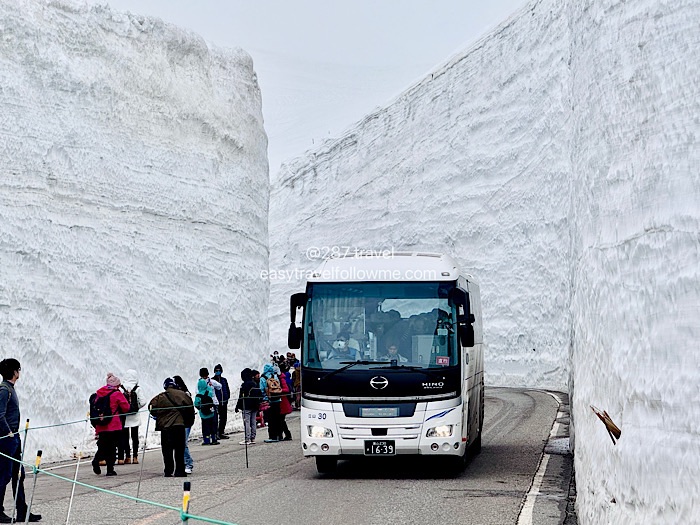
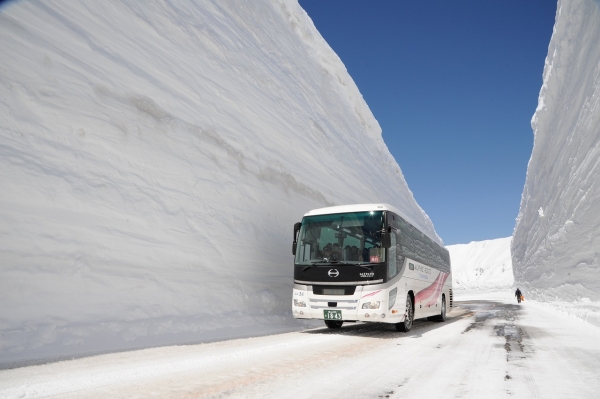
This is one of the longest segments of the entire Alpine Route and offers the most diverse changes in scenery. Spring features the magnificent Yuki-no-Otani (Great Snow Wall) as the main attraction, where the towering walls of snow make you feel as if you are in a snowy tunnel. In summer and autumn, you can see vast alpine meadows, lush green forests, and turning red leaves.
The Tateyama Highland Bus runs between Bijodaira and Murodo, with several stops along the way such as Midagahara and Tengudaira. You can get off at these stops to walk the trails, take photos, and even observe alpine plants and wildlife. The entire journey involves a large elevation drop, climbing from the lowlands all the way to the Murodo plateau, allowing travelers to experience the transition from the base to the high mountains in a short period.
Tateyama Tunnel Trolley Bus (Murodo ⇄ Daikanbo)

This trolley bus runs through a tunnel directly beneath the summit of Mount Tateyama, making it the section of the Alpine Route that is closest to the mountain’s core.
Originally operated as a trolley bus, this route was fully upgraded in 2018 to more eco-friendly and quiet electric buses, and you can hardly hear the engine while riding. Because the route goes deep into the mountainside, there isn’t much scenery to see out the window, but you can feel the powerful atmosphere of traveling underground, making it a unique transportation experience.
Tateyama Ropeway (Daikanbo ⇄ Kurobedaira)

The greatest feature of this ropeway is that there are no support towers along the entire line; it is supported only by a single cable. With a total length of about 1.7 km, it is the longest pylon-less aerial tramway in Japan.
The cabin hangs in mid-air above deep valleys, giving passengers the sensation of floating among the clouds. While riding, you can look out over the Tateyama mountain range, Kurobe Lake, and the magnificent alpine scenery around Daikanbo. On clear days, you can even see the distant peaks of the Northern Alps.
Kurobe Cable Car (Kurobedaira ⇄ Kurobe Lake)

This is Japan’s only funicular that operates entirely within an underground tunnel.
Although the route is short, the slope is steep as it slides all the way from Kurobedaira down to the shores of Kurobe Lake.

Along the way, you will feel a significant drop and the special atmosphere of a confined space, making it the section with the most “underground exploration” feel on the entire route.
While you cannot enjoy the scenery outside the window, this cable car demonstrates Japan’s technical achievements in mountain tunnel transportation engineering and is a pilgrimage site for many railway fans.
Kanden Tunnel Electric Bus (Kurobe Lake ⇄ Ogizawa)

This is the final segment of the route, traveling from Kurobe Lake to Ogizawa on the Kanden Tunnel Electric Bus. Originally operated as a trolley bus, it was changed to brand-new electric buses in 2019, which are not only more environmentally friendly but also quieter and smoother to ride.
This tunnel was originally excavated as a construction path for building the Kurobe Dam. Covering a total length of about 6.1 km, it was once an important engineering artery and has now become part of the sightseeing route.

Whether you are a fan of taking public transport or prefer driving, the Tateyama Kurobe Alpine Route is worth experiencing for yourself at least once!
As long as
you plan your transportation connections and ticket arrangements well, all that’s left is to enjoy the magnificent snow walls and clear lake views along the way.
That’s all for now. If you have any questions, feel free to send a direct message to Tsubaki’s travel Instagram. I hope everyone has a smooth journey through Tateyama Kurobe!
★ Suggested Reading for Tateyama Kurobe:
“Introduction to Tateyama Kurobe Travel“
“Opening Times, Seasons, and clothes“
“Tateyama Kurobe Transport Guide & Notes“
“Ticket Booking Methods and Precautions“
Tateyama Kurobe Transport & Self-Driving FAQ
Can I drive through the Tateyama Kurobe Alpine Route myself?
No. To protect the high-altitude environment, private vehicles are strictly prohibited from the entire Alpine Route between “Tateyama Station” and “Ogizawa Station”. Self-driving travelers must park their vehicles at the station parking lots at either end and transfer to the six official eco-friendly modes of transport to head up the mountain.
If I drive to Tateyama Kurobe, where is the best place to park? How much is the parking fee?
If you plan to do a round trip, you can park your car at the parking lots around “Tateyama Station” on the Toyama side or “Ogizawa Station” on the Nagano side. Both sides offer free and paid parking options; however, free spots fill up quickly during peak seasons, so it is recommended to arrive as early as possible.
What happens to my car if I want to enter from Tateyama and exit from Ogizawa (one-way)?
If you wish to traverse the Alpine Route one-way, you can use the local “Car Delivery (Vehicle Forwarding) Service”. A delivery company will drive your car from the entrance station to the exit station to meet you. The fee for a one-way delivery is approximately 27,000 JPY, and it typically requires a reservation via the internet or phone in advance.
Can I bring large suitcases on the various modes of transport?
While it is permitted, it is highly discouraged. Because you need to constantly transfer between cable cars, trolley buses, and highland buses, carrying large luggage is extremely inconvenient and crowded. It is strongly recommended to use the official “Luggage Forwarding Service”; drop off your bags at the departure station in the morning, and you can pick them up at the station or designated hotel on the other side in the afternoon.
**********************
Traveler’s Note:
The insights shared above are based on my personal experiences and subjective perspectives. When planning your trip, please consider current weather conditions and your own travel preferences.
Please note that all English articles on this site are AI-assisted translations of the original Traditional Chinese content. While every effort is made to ensure accuracy and natural flow, occasional nuances or expressions may differ. Thank you for your understanding.
In an era dominated by viral trends and “clickbait” locations, my true passion lies in exploring hidden corners and regions where information is scarce. I know firsthand how precious detailed, reliable information is when planning a journey. That is why I dedicate countless hours to research and field exploration, to curate these hard-earned insights for fellow travelers like you.
Every article and image on this site represents a significant investment of time and heart. If this content has helped you, the best way to support me is by sharing or reposting this link. I kindly ask that you respect original creators; unauthorized copying or re-uploading is strictly prohibited (all content is protected under DMCA).
Catch my latest travel moments on Instagram: @287.travel
Fuel my next journey: If my guide made your trip smoother, feel free to [Buy Me a Coffee]. Your support keeps this project moving forward!
Thank you for being a part of this community.

**********************
Klook.com