
Last Updated on 2026-10-13 by Tsubaki
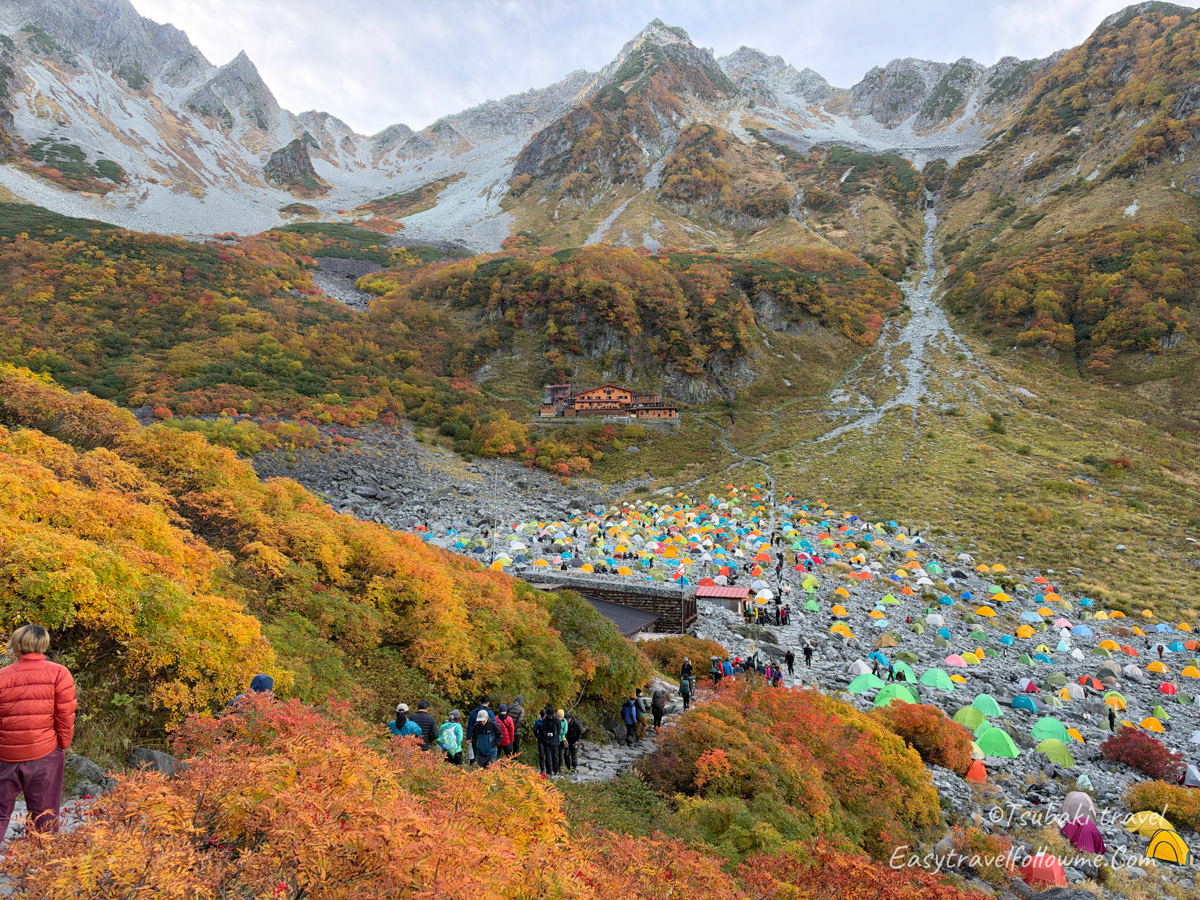
Hi! I’m Tsubaki 287, a freelance contributing travel journalist who has lived in Japan since 2016! Every autumn, particularly during the foliage season, camping at Karasawa Cirque in Nagano is a dream for many hikers. I’d always wanted to stay after seeing photos of hundreds of colorful tents beneath the Hotaka mountains. In autumn the valley turns red, gold and orange, and at night the tents light up under a sky full of stars. Sunrise on the Hotaka peaks is another extraordinary moment you can only experience by staying overnight.
But after carrying our tent and sleeping bags up the mountain, I can say this: Karasawa is beautiful, but it’s much harder than I expected. The campsite isn’t a flat grassy meadow. It’s covered in large rocks. After hiking for five to six hours from Kamikochi with heavy packs, we still had to find a place, move stones, and pitch the tent.
Here’s what I learned from actually camping at Karasawa Cirque: campsite fees and registration, rocky pitches, mountain-hut facilities, tent and stove rentals, drinking water, food, and the equipment worth carrying uphill.
I’ll cover the full hiking route to Karasawa in another guide. This article focuses on what it’s really like to spend one night in the cirque, particularly practical campsite facilities and the challenge of setting up a tent on uneven ground.
Switch language:
When Is Autumn Foliage at Karasawa Cirque at Its Best?

Autumn colors at Karasawa generally appear between late September and mid-October, although the exact peak varies with weather, temperature and snow. The higher elevations usually change color before Kamikochi, starting on the upper mountainsides and gradually moving downhill.
Early to mid-October often offers a good chance of seeing vivid autumn colors, but conditions change rapidly. A few days can mean the difference between the first red leaves, peak color and fallen foliage.

We camped at Karasawa on October 3–4. The whole valley wasn’t completely red yet, but the mountainsides were showing clear patches of yellow, orange and red.
I personally loved the scenery at this stage.

The varied colors created wonderful layers alongside the rugged Hotaka cliffs, blue sky and colorful tents. I found this as beautiful as an entirely red valley.
If you visit in early October, don’t worry too much if the foliage hasn’t peaked. As soon as colors begin to change, Karasawa is already impressive, and you might avoid the most crowded peak days.
Remember that foliage season is one of Karasawa’s busiest periods. On sunny weekends, the campsite fills quickly, and flat pitches and rental boards can disappear early. Starting your hike from Kamikochi as early as possible is a good idea.
Peak foliage doesn’t happen on a fixed date. Look at current mountain-hut announcements, recent hikers’ photos and that year’s foliage reports before departing.
Is Free Drinking Water Available at Karasawa Cirque?
Karasawa Hutte generally provides free drinking water near the hut, supplied by groundwater in the Kita-Hotaka stream area. However, availability depends on water conditions, particularly after prolonged dry weather.
Free drinking water does not mean free hot water. For instant noodles, coffee or other hot food, you’ll still need your own stove or a rented SOTO stove and cookware kit, if available.
Bring enough water for the hike up from Kamikochi. Only plan to refill at Karasawa after confirming current conditions, and follow signs or staff advice for the designated water point.

One important warning: water supply at a high-altitude campsite is not guaranteed. During dry spells the source can run low. In October, Karasawa Hutte’s official Facebook page announced that the water supply had become unreliable and asked hikers to bring their own. Check the latest notices before departing instead of counting on a refill.
>>Karasawa Hutte: official Facebook updates
Can You Hike to Karasawa Cirque and Return in One Day?
Walking from Kamikochi to Karasawa generally takes around five to six hours one way. A round trip can exceed ten hours before counting rests, meals, photography or actually enjoying the view. I personally wouldn’t recommend treating it as a casual day hike.
Some of Karasawa’s most beautiful moments occur at sunrise and dusk. It feels like a shame to hike all the way there, take a couple of photos and immediately turn back. If time and fitness permit, consider staying one night in a mountain hut or tent.

The moments I remember best came after we stayed. Tents slowly lit up as evening fell, stars appeared overhead, and the morning sun coloured the Hotaka peaks as we climbed out of our sleeping bags.
After making such an effort to reach the valley, I think those overnight experiences are absolutely worth including.
Where to Stay at Karasawa: Mountain Hut or Camping?

Visitors can stay in a mountain hut or camp at Karasawa. Campers can carry their own tent or, when available, reserve a pre-pitched rental tent in advance. If you don’t want to carry a tent, sleeping bag and sleeping mat all the way up, a hut is much easier and is particularly helpful for hikers without camping equipment.
Camping means sleeping right in the cirque. You can open your tent to views of the Hotaka peaks and wake up to sunrise with little preparation. The trade-off is having to carry all your gear up the mountain yourself.
I chose to camp. Because I haven’t personally stayed in the mountain huts, the rest of this article focuses on the campsite rather than pretending to review hut accommodation.
Karasawa Campsite: Register on Arrival
The campsite generally operates on a walk-in rather than advance-reservation basis. Hikers head up, find a pitch and register, although the order of finding a spot and checking in can vary.

The registration counter is in the middle of the camping area, not inside the mountain hut. You don’t need to go into the hut to register.

When we visited, the fee was ¥2,000 per adult and ¥1,000 per child, payable at the central registration point. Confirm current pricing before your hike.
* 2,000 JPY (≈ $12.64 USD / £9.56 GBP / €11.30 EUR)
After registration, staff give you a camping permit tag, and you can choose a place and pitch your tent.
The tag needs to hang outside your tent so staff can check it. I recommend bringing a small S-hook or carabiner: it weighs almost nothing and makes attaching the permit surprisingly easy.
There are no assigned pitches. You find a suitable place yourself, and the flatter spots are usually taken first. Arriving early is especially helpful on weekends and during the autumn foliage season.

Before hiking back down, don’t forget to return your permit tag to the designated collection box.
Karasawa Campsite Is Covered in Rocks, Not Grass

If your idea of camping is a huge flat lawn where you simply unfold the tent, Karasawa will come as a shock.
The campsite is made up of large, irregular stones and boulders—not just fine gravel.

Some spots have been levelled by earlier campers, with rocks moved away so the ground is easier to pitch on.
Everyone wants those spots, of course. On weekends and during foliage season, early arrivals usually take them. That’s why your arrival time matters so much.
Wooden Boards Can Be Rented for Your Tent

If you can’t find a flat spot, the campsite has boards that can go under a tent to make the ground more even and protect its floor. They cost ¥500 per board during our visit; a larger tent might need two.
We noticed many campers collected boards and set up their tents before returning to the counter to pay. On arrival, check availability and find a suitable spot promptly.
* 500 JPY (≈ $3.16 USD / £2.39 GBP / €2.83 EUR)The problem is that the boards are limited. By the time we arrived around 2 p.m., they’d all been taken. The photograph here was shot the next morning after they were returned. Don’t assume that rental boards will always be available, especially in peak autumn.
We Arrived Around 2 p.m. and Most Good Spots Were Gone

We reached Karasawa around 2:30 p.m. By then, the well-prepared flat pitches were occupied, and no rental boards remained.
We finally found a small area, but it wasn’t ready for a tent. Ugo and I moved large stones one by one, then used smaller stones to fill uneven sections and make the surface as level as we could.
At that moment I understood just how much effort earlier campers had put into preparing the better pitches. If possible, leave Kamikochi earlier: you’ll enjoy an easier hiking pace and have more choice once you reach camp.
Sleeping Mat Choices: Comfort Versus Weight

With a full camping pack to carry for five or six hours, minimizing weight really matters. Bring the essentials and think carefully about everything else.

We carried an inflatable sleeping mat, and it was genuinely comfortable. It helped smooth out some of the unevenness of the stones beneath our tent.
But after hiking for hours with it, I wondered whether I really needed that much comfort. Next time I’d consider a lightweight folding foam mat, which is harder to puncture on sharp rocks and much lighter.
Everything—tent, sleeping bag, mat, food, water and clothing, has to come up on your back. Even a few hundred extra grams make a difference late in the climb. On a drive-in campsite I’d choose comfort; at Karasawa I’d prioritize lighter equipment.
Karasawa Camping Packing List: Warm Layers, Headlamp and Sleeping Mat

Pack as lightly as you reasonably can, but don’t skip the essentials. You’ll need a tent, suitable sleeping bag and sleeping mat, along with rain gear, a power bank and regular hiking equipment. Extra warm clothes are non-negotiable.
Karasawa is at high altitude and much colder than the valley below, especially after sunset. Hiking keeps you warm, but once you stop to pitch the tent, eat dinner or sit outside, the temperature feels completely different.
Besides your hiking clothes, bring an additional insulating layer for camp, such as fleece or a lightweight down jacket. You’ll appreciate it even more before dawn when you get up to see the first sun touch the Hotaka mountains. Comfortable weather at Kamikochi does not mean warm conditions at Karasawa.
Another absolute essential is a headlamp or flashlight; I strongly prefer a headlamp. The campsite gets extremely dark at night, and walking from your tent to the toilet means navigating irregular rocks with very little lighting. Even in daylight you have to watch your feet.
Carry a light every time you leave the tent after dark. A headlamp frees up both hands for putting on shoes, finding supplies and walking safely. Keep it beside your sleeping bag so it’s within reach at night.
Think carefully before bringing a table, chairs, large cookware or other nice-to-have items. You have to carry every gram uphill, and an extra half-kilo starts to feel different after several hours.
Renting Tents, Sleeping Bags and Stoves at Karasawa
If you want to camp at Karasawa Cirque without carrying a tent, sleeping bag and cooking equipment all the way from Kamikochi, there’s another option.
Before the trip I checked the official information from Karasawa Hutte (涸沢ヒュッテ). In addition to wooden boards for tent pitches, the hut offers pre-pitched rental tents, sleeping bags, sleeping mats, and SOTO gas stoves with cookware. That’s an appealing choice if you want to try high-altitude camping but are worried about carrying a heavy pack.
I knew some gear could be rented, but I stubbornly insisted on bringing our own equipment. Let’s just say I regretted that decision a little during the hike!
Tent Rental Prices and How to Book
According to the official rental information, a four-person tent costs ¥12,000 per tent, plus the separate campsite fee of ¥2,000 per adult per night. For a group splitting the cost, this can be more affordable than mountain-hut accommodation, depending on the rates and group size.
* 12,000 JPY (≈ $75.84 USD / £57.36 GBP / €67.80 EUR)The rental tents are set up in advance by staff. After arriving, go to the campsite’s central registration counter, where staff will direct you to your assigned tent. You won’t have to look for a flat pitch or move rocks to prepare the ground.
Rental tents are a seasonal service, generally available from around mid-July to mid-October. Exact dates can change each year. The tents are intended for approximately two to four guests and must be booked online through Yamatan (やまたん). Under the official booking rules described in the original article, reservations open 14 days before check-in and close two days before arrival.
Rental-tent guests can also add a sleeping bag for ¥3,000 and a sleeping mat for ¥1,000. These additional rentals are reserved for guests who book a rental tent; they aren’t generally offered to campers bringing their own tent.
* 3,000 JPY (≈ $18.96 USD / £14.34 GBP / €16.95 EUR) * 1,000 JPY (≈ $6.32 USD / £4.78 GBP / €5.65 EUR)Remember: Bringing your own tent usually does not require advance campsite booking, but reserving a pre-pitched rental tent does.
SOTO Gas Stove and Cookware Rental
Karasawa Hutte also offers a rental cooking kit from Japanese outdoor brand SOTO. It can save weight if you’d like to make instant noodles, boil water or cook a simple meal at camp.
The published price is ¥3,500 per set. The set includes a gas stove, gas canister, two-piece cooking pot set and a small cooking table.
* 3,500 JPY (≈ $22.12 USD / £16.73 GBP / €19.78 EUR)Unlike rental tents, the cooking sets can’t be booked in advance. They must be rented in person from the outdoor shop at Karasawa Hutte, depending on availability when you arrive.
The published equipment list doesn’t include chopsticks, spoons or individual dishes, so I’d bring your own utensils.
>> Rental tent reservations: Yamatan – Karasawa Hutte rental tent booking
Which Equipment Should You Still Bring?
We carried all our equipment uphill, then had to move rocks to make the tent pitch usable. Knowing just how tiring that was, I’d seriously consider a pre-pitched tent next time.
Even with a rented tent, don’t leave behind proper warm layers, rain gear, a headlamp and sleeping equipment suitable for the temperatures. Karasawa is at high altitude, and the weather can change rapidly.
Cooking equipment and wooden boards are limited walk-in rentals. You can’t assume they’ll be available in peak season, so check current rental policies and have a backup plan.
>> Official information: Karasawa Hutte rentals and accommodation
>> Rental tent reservations: Yamatan – Karasawa Hutte rental tent booking
Rental seasons, prices and booking conditions may change. Always confirm the latest official announcements before your trip.
Can Campers Use the Mountain-Hut Toilets?
Yes. Campers can use the toilets associated with the huts. When we visited, non-campers and non-hut guests were charged ¥100. Check current rules when you arrive.
At night, use your headlamp or flashlight. The trail across the rocky campsite isn’t lit like a city path, and even a short walk can be hazardous in darkness.
I also want to share one lesson I learned the hard way, especially for female campers.

On our visit, there were mixed-gender toilets on the right and female-only toilets on the left.
When I first arrived, I didn’t notice the difference and went into the mixed toilet.
Well…
Let’s just say the state of the facilities inside was quite a shock. The toilet was dirty and the smell wasn’t pleasant.
Another camper kindly told me about the women-only toilets, which were much cleaner during our visit. If you’re a female camper, look carefully at the signs.
Bring Camp Shoes, but Avoid Flimsy Flip-Flops
Having something easy to slip on around camp is convenient; you don’t want to lace up hiking boots every time you leave the tent.
However, Karasawa’s rocky, uneven surface makes ordinary flip-flops a bad choice. Stubbed toes are one thing, but twisting an ankle would be a bigger problem when you still have hours of hiking to get back down.
On the trail we even passed a hiker who appeared to have injured their nose and was using tissue to stop the bleeding. Injuries are more serious when evacuation takes hours on foot. If you bring camp shoes, choose lightweight ones with better coverage and secure soles.
No Stove? The Mountain Huts Sell Hot Meals

I had assumed camping at Karasawa meant preparing all our own meals.

Once we arrived, I was surprised by how many food options were available.

You could buy hot dishes such as ramen, beef bowls and oden, plus bread, potato chips, milk, beer and other snacks.

If you don’t want to carry ingredients uphill, buying some meals at the mountain huts is a good alternative. After walking for five or six hours, a hot meal in the mountains tastes especially good.
Hot Water Isn’t Free for Your Own Instant Noodles
One detail many first-timers overlook: although the huts sell meals, they do not provide free hot water for campers to prepare their own food. If you bring instant noodles, you’ll need your own stove, fuel and cookware to boil water.
Alternatively, buy instant noodles from the hut and they can prepare them with hot water. Another option is to rent a SOTO stove and cookware kit on arrival, subject to availability. Don’t plan to borrow free hot water for your own noodles.
Electronic Payments May Work, but Bring Cash
Some electronic payment methods were accepted at the mountain huts when we visited.
However, you’re still high in the mountains, and the signal may be unreliable. If the network goes down, electronic payments may not work. Bring enough Japanese yen in cash even if you normally use cards or mobile payments everywhere.
You might need cash for camping, food, other facilities or toilets, so don’t rely on your phone alone.
Stay Awake to Watch the Tents Light Up at Dusk
One scene I had eagerly anticipated was the colourful tents slowly lighting up as the sun set. During the day they fill the valley with colour; at night they become tiny points of light scattered across the mountains.
With the Hotaka peaks around the campsite, this magical scene is one reason people choose to stay overnight in autumn.

Unfortunately, we were so exhausted after pitching our tent that we fell asleep and woke up when it was already dark. We missed the lights coming on one by one! If you want to photograph them, set an alarm.
Get Up Early for Sunrise on the Hotaka Peaks

If tents glowing at dusk are the romance of Karasawa, sunrise illuminating the mountains is the one view you absolutely shouldn’t miss.

After sunrise, the light gradually hits the Hotaka range, turning the cool grey cliffs orange and red. It happens quickly, so don’t wait until everyone else is taking photos to climb out of your sleeping bag.
Check sunrise time the night before, get up early, put on warm clothes, and have your camera ready. It’s freezing in the morning, but seeing the first sunlight on the peaks makes the previous day’s tough climb worthwhile.
Morning Stretching With Mountain-Hut Staff

Another charming Karasawa memory is the group morning exercise session.
After everyone gets up, staff guide some gentle movements to loosen up stiff muscles. After hiking for hours the day before, the stretching felt good.
Doing exercises with strangers under the Hotaka peaks felt like a lovely glimpse of Japanese mountain-hut culture.
Is Karasawa a Good Place for First-Time Campers?

If you’ve never pitched a tent in your life, I wouldn’t recommend starting at Karasawa. It’s not just the campsite: you must hike five or six hours carrying all your equipment, then potentially move rocks to make a pitch, cope with low temperatures and pack everything out the next morning.
Minor inconveniences at an ordinary campsite become bigger problems in the mountains. But if you have hiking experience and know how to use a tent, sleeping bag and mat, Karasawa is a rewarding challenge.
Karasawa Campsite Facilities: What’s Available and What Isn’t?

Here’s a practical checklist for anyone planning their first night at Karasawa.
Facilities and items you may be able to use or buy:
・mountain-hut toilets
・hot meals such as ramen
・beef bowls and oden
・instant noodles
・bread and snacks
・drinks such as milk and beer
・limited wooden-board rental
・pre-pitched tent rental by advance reservation
・optional sleeping bags and mats for rental-tent users
・walk-in stove and cookware rental
・drinking water when supplies permit
・some electronic payments.
Things you shouldn’t assume will be available:
・a flat camping pitch
・enough rental wooden boards or cooking sets
・reliable drinking water during dry spells
・free hot water for your own noodles
・reliable mobile reception; electronic payments at all times.
Essential equipment I’d pack:
・tent
・mountain-rated sleeping bag
・lightweight sleeping mat
・hiking clothes and extra warm layers for camp
・rain gear
・headlamp or flashlight
・power bank; enough cash
・small carabiner
・stove, fuel and cookware if making your own meals
・secure lightweight camp shoes
・toothbrush and toothpaste
・wet wipes
・towel
As for extra food, tables, chairs and other camping comforts, my rule is simple: if you don’t need it, don’t carry it. Every extra item adds weight to your shoulders.
At-a-Glance Campsite Facilities Checklist

Facility / Service | Availability | Details and Important Notes |
Toilets | Available | Toilet maintenance fees are generally included in the camping fee. Day hikers and other visitors are asked to contribute ¥100. |
Drinking Water | Available | Drinkable water is available at the mountain hut. Although the water looks clear, boiling it before drinking is recommended. |
Hot Water | Not provided | Free hot water is not available for campers. You’ll need to bring your own camping stove and gas canister to boil water. Alternatively, you can purchase instant noodles at the mountain hut, where staff will add hot water for you. |
Garbage Disposal | Limited | All personal trash must be carried back down the mountain! Only waste from food and items purchased at the mountain hut’s shop may be disposed of there. There are no public trash bins on the mountain. |
Hot Meals & Snacks | Available | The mountain hut offers a surprisingly wide selection of food and drinks, including ramen, gyudon (beef rice bowls), oden (Japanese hot pot), bread, milk, potato chips, draft beer, and more! |
Wooden Board Rental | Limited availability | Wooden boards can be rented for ¥500 each. Supplies are limited, so they may run out if you arrive late. |
Mobile Reception | Unreliable | Mobile signals are weak and intermittent, so bringing enough cash is highly recommended. Starlink internet access may also be available for purchase. |
My Karasawa Camping Experience: Tough but Worth the Night

This isn’t the kind of campground where you park beside your pitch and unload the trunk. Everything has to be carried uphill. After five or six hours of walking, you don’t arrive on a neat lawn—you arrive among rocks.
By the time we arrived, the best spots had been taken. We moved large rocks and carefully used smaller ones to fill gaps. It was messy and exhausting. Yet the next morning, watching sunlight spread over the Hotaka peaks, I suddenly felt that everything we’d carried up was worth it.
The cirque is already stunning as a hiking destination, but if you’re fit and equipped to stay overnight, I’d recommend doing so. The illuminated tents, mountain stars and morning light are experiences a day visitor simply can’t enjoy in the same way.
Final Thoughts
Camping at Karasawa requires carrying a heavy pack and preparing a rocky tent pitch, but watching the tents light up at night and waking to glowing mountain peaks makes the effort meaningful.
I hope this article helps you understand the campsite’s conditions before you head up. It’s not an easy overnight trip: you need fitness and patience for the hike, finding a pitch and preparing the ground.
Travel light, arrive early, bring sufficient cash, and watch your footing on the rocks. With the right preparation, camping at Karasawa can become one of your most memorable mountain experiences.
Karasawa Cirque Camping FAQs
Do I need to reserve a campsite at Karasawa?
If you bring your own tent, the campground generally accepts campers without advance reservations. Register at the central campsite counter and display the permit tag outside your tent. Pre-pitched rental tents, however, must be reserved beforehand.
Foliage season, sunny weekends and holidays get busy, so start from Kamikochi early if you hope to get a flatter pitch or rent wooden boards.
How long does it take to hike from Kamikochi to Karasawa?
Allow around five to six hours from Kamikochi, depending on fitness, weather, pack weight, breaks and trail conditions.
If you’re carrying a tent, sleeping bag, mat, water and food, you may take longer than someone with a day pack. Leave plenty of time and don’t start too late.
Can Karasawa Cirque be visited as a day hike?
Technically yes, but I wouldn’t recommend it for most hikers. A round trip can exceed ten hours, without time for breaks and photographs, and becomes risky if weather worsens or you’re slow on the descent.
If possible, stay overnight to experience the glowing tents, stars and sunrise on the Hotaka peaks.
What overnight accommodation is available at Karasawa?
There are two main accommodation styles: mountain huts and camping. At the campsite, you can bring your own tent or book a pre-pitched rental tent when the service is offered.
A mountain hut involves carrying much less gear and can be easier for inexperienced mountain campers. Bringing your own tent means carrying your equipment; a pre-booked rental tent can significantly reduce that load.
Can I rent wooden boards at Karasawa Campground?
Yes, but supplies are limited. Boards help create a flatter surface and protect the tent floor from rocks. During our visit they cost about ¥500 each; large tents may need two.
Boards often run out during weekends and foliage season, so don’t rely on being able to rent them.
Are there toilets at the Karasawa campsite?
Yes. Campers can use the mountain-hut toilets. Visitors who aren’t camping or staying at the huts may need to pay ¥100. Bring a headlamp when walking across the rocky ground at night.
Female campers can look for the women-only facilities, which were more comfortable during my visit.
Is free hot water available for campers?
No. Bring your own stove, fuel and cookware if you want to prepare instant noodles or other hot food.
Alternatively, you can buy instant noodles from the mountain hut, where staff will prepare them with hot water.
When are autumn leaves most beautiful at Karasawa?
Colours normally change from late September to mid-October, with early to mid-October often a good window for bright autumn foliage.
The exact timing depends on weather and snow, so check current mountain-hut notices, foliage reports and recent hikers’ photographs before setting off.
**********************
Traveler’s Note:
The insights shared above are based on my personal experiences and subjective perspectives. When planning your trip, please consider current weather conditions and your own travel preferences.
Please note that all English articles on this site are AI-assisted translations of the original Traditional Chinese content. While every effort is made to ensure accuracy and natural flow, occasional nuances or expressions may differ. Thank you for your understanding.
In an era dominated by viral trends and “clickbait” locations, my true passion lies in exploring hidden corners and regions where information is scarce. I know firsthand how precious detailed, reliable information is when planning a journey. That is why I dedicate countless hours to research and field exploration, to curate these hard-earned insights for fellow travelers like you.
Every article and image on this site represents a significant investment of time and heart. If this content has helped you, the best way to support me is by sharing or reposting this link. I kindly ask that you respect original creators; unauthorized copying or re-uploading is strictly prohibited (all content is protected under DMCA).
Catch my latest travel moments on Instagram: @287.travel
Fuel my next journey: If my guide made your trip smoother, feel free to [Buy Me a Coffee]. Your support keeps this project moving forward!
Thank you for being a part of this community.

**********************
Klook.com